Remittances from Overseas Pakistanis - Updates

Same here came as a pre-teen kid in the late 80's, spend every summer in Pakistan and didn't want to come back to US until last time couple of times. Couldn't wait to get out and eversince the jamedar/wadera utopia is in full swing, have no desire to go back.
Wow, so you got to see Pakistan before it de-industrialized, and while it was being radicalized and Kalashnikov culture was taking over. Anything indicate to you this trend can be reversed?, now that Pakistanis see what this looks like in full effect across the border, and the GWOT is over (no more money left to play the charade of externally forcing cultures to change from what they actually are) ?

IMHO, returning to our native and natural culture is an imperative component to setting the country back on track. Sectarianism should not be allowed to be a defining characteristic of society, where someone needs to know your ancestry, whether to know to work with you.
 
Wow, so you got to see Pakistan before it de-industrialized, and while it was being radicalized and Kalashnikov culture was taking over. Anything indicate to you this trend can be reversed?, now that Pakistanis see what this looks like in full effect across the border, and the GWOT is over (no more money left to play the charade of externally forcing cultures to change from what they actually are) ?

IMHO, returning to our native and natural culture is an imperative component to setting the country back on track. Sectarianism should not be allowed to be a defining characteristic of society, where someone needs to know your ancestry, whether to know to work with you.
In my observation and being a devout military partisan in the past, Pakistan's ills whether economic, societal, religious or governance related all have one source only, i.e. the mil-establishment. I base this conclusion largely on one fateful night and events subsequent to that have cemented this belief.

The fateful night was when the biggest terrorist in Pakistan's history Altaf Hussain and his MQM were made completely irrelevant after a solitary low key raid on their headquarters, after reigning over with impunity committed all gamut of crimes against the citizens and officials of Karachi for three decades with impunity.

All can be fixed in Pakistan, it can be industrialized, extremism and terrorism can be tempered, law and order situation can improve, if the mil-establishment wants it...
 
In my observation and being a devout military partisan in the past, Pakistan's ills whether economic, societal, religious or governance related all have one source only, i.e. the mil-establishment. I base this conclusion largely on one fateful night and events subsequent to that have cemented this belief.

The fateful night was when the biggest terrorist in Pakistan's history Altaf Hussain and his MQM were made completely irrelevant after a solitary low key raid on their headquarters, after reigning over with impunity committed all gamut of crimes against the citizens and officials of Karachi for three decades with impunity.

All can be fixed in Pakistan, it can be industrialized, extremism and terrorism can be tempered, law and order situation can improve, if the mil-establishment wants it...
Sadly it seems more true everyday, as all other layers of the onion are peeled back and it’s down to one power corridor, that could act but refuses to do so.

Look at Bangladesh’s military. Pulled backed their support for Hasina and the dominos fell.

This is why, if they are afraid of the economic, national and personal, fallout of doing the same in Pakistan, they should meet with Pakistanis from all backgrounds and find a way to survive any blowback from a course correction. Have the American diaspora set up businesses in Pakistan as joint ventures with American firms to keep American politicians friendly to Pakistan. Do the same in all other parts of the world. Have local investors come back from Dubai but find a different way to do even more business with Dubai to offset the loses. All this will protect career and retirement opportunities for members of the establishment.

As much of the current elite need to be brought along with a new vision to make sure dissidents don’t persist that could undermine the change, as they are planning to do in Bangladesh.
 

Remittances jump by 44pc in two months

Shahid Iqbal
September 10, 2024

KARACHI: Overseas Pakistanis sent 44 per cent more remittances in the first two months (July and August) of the current fiscal year (FY25), compared to the same period of the previous fiscal year.

In July, remittances went up by 48 per cent year-on-year, setting a trend of higher inflows. The receipts for July were $2.994 billion, but it dipped to $2.942bn in August.

According to data issued by the State Bank on Monday, the inflows during July-Aug FY25 rose to $5.936bn, while inflows in the same period of previous fiscal year FY24 was $4.123bn — an increase of $1.813bn, or 44 per cent.

The inflows must be a relief for the government at a time when it is struggling to strike a deal with the IMF for $7bn. This inflow would not only improve Pakistan’s image in the eyes of international rating agencies but will also open doors for other sources.

Pakistan is in dire need of dollars for debt servicing of $25bn in FY25.

The country managed to bring down the current account deficit in FY24 to a negligible $665 million while it was just $162m in July FY25. Although the economy suffered due to restricted imports and growth fell to just 2.4 per cent in FY24, the government succeeded in tackling the or current account deficit.

According to financial experts, if remittances keep improving at the same pace, the country would be able to increase its imports to spur growth.

Data showed that inflows from almost all destinations rose during the first two months while the highest increase among important destinations was from the UAE.

Remittances from UAE jumped by 84.3 per cent to $1149m from $624 in the first two months of the previous fiscal year.

However, the highest inflows were from Saudi Arabia, which rose 50.7 per cent. Remittances from Saudi Arabia shot up to $1.473bn during July-Aug FY25, compared to the same period of last year fiscal year.

The other important inflows were $ 918.3m from UK (up by 44.4 per cent); USA $622.4bn (up 23.5 per cent); GCC countries $569.7m (up20.4 per cent) and EU countries $726.6 per cent (up 26.5 per cent). The inflow from EU has exceeded the inflows from the GCC countries.

Currency experts said one of the reasons for higher remittances is the tough stance of the government against illegal currency business. They said the currency smuggling and Hundi and Hawala system are working at the lowest level.

Currency dealers in the open market also reported higher inflows as they have started selling more dollars in the banking market. The inter-bank market is showing stability in the exchange rate — a big attraction for exporters to sell their proceeds while it is also attractive for foreign investors.

Published in Dawn, September 10th, 2024
 
Overseas Pakistanis need to boycott remittance and also stop any
investment in Pak until the mandate of the people is respected by
the Duffers in GHQ.

Well no major investment has come to Pakistan since the military coup..

I am still waiting for the 100 Arab chachoo whisky promised
 
It would be logical for overseas Pakistanis to take advantage of current exchange rates, it's a well known fact that people work and earning abroad use that money to buy up land in their homeland.

Recently usd/INR has been at 83 at exchange, Indian desis have been pumping money in Indian real estate across Punjab Gujarat AP from here as well...
 
Sadly it seems more true everyday, as all other layers of the onion are peeled back and it’s down to one power corridor, that could act but refuses to do so.

Look at Bangladesh’s military. Pulled backed their support for Hasina and the dominos fell.

This is why, if they are afraid of the economic, national and personal, fallout of doing the same in Pakistan, they should meet with Pakistanis from all backgrounds and find a way to survive any blowback from a course correction. Have the American diaspora set up businesses in Pakistan as joint ventures with American firms to keep American politicians friendly to Pakistan. Do the same in all other parts of the world. Have local investors come back from Dubai but find a different way to do even more business with Dubai to offset the loses. All this will protect career and retirement opportunities for members of the establishment.

As much of the current elite need to be brought along with a new vision to make sure dissidents don’t persist that could undermine the change, as they are planning to do in Bangladesh.
I’m glad these thoughts were echoed today on this video.
To view this content we will need your consent to set third party cookies.
For more detailed information, see our cookies page.
 
Pakistan’s remittance inflow stands at $2.85bn in September 2024, up 29% year-on-year
Amount marginally lower than in August 2024
During 3MFY25, remittances up nearly 39% YoY to $8.8 billion as compared to $6.3 billion in 3MFY24
BR Web Desk Published October 9, 2024 Updated about 3 hours ago
Facebook
Twitter
Whatsapp
Comments

37
Follow us
Inflow of overseas workers’ remittances clocked in at $2.849 billion in September, a massive 29% higher on a year-on-year (YoY) basis when compared with $2.208 billion in the same month of the previous year, showed data released on Wednesday by the State Bank of Pakistan (SBP).

On a month-on-month (MoM) basis, the inflow in September was 3% lower when compared to $2.943 billion in August 2024.

During 3MFY25, remittances went up by nearly 39% YoY to $8.8 billion as compared to $6.3 billion in 3MFY24.

Experts credit the increase in inflows to the stability of the PKR exchange rate, a narrowing gap between open and inter-bank market rates, and a rise in the number of workers relocating abroad.

“These stronger inflows will help Pakistan maintain PKR stability and containing the current account deficit,” said Mohammed Sohail, CEO of brokerage house Topline Securities, in a note.

Home remittances play a significant role in supporting the country’s external account, stimulating Pakistan’s economic activity as well as supplementing disposable incomes of remittance-dependent households.

Pakistan’s remittance inflow stands at $2.9bn in August, up 40.5% year-on-year

Breakdown of remittances

Overseas Pakistanis in Saudi Arabia remitted the largest amount in September 2024 as they sent $681.3 million during the month. The amount declined by 4% on a monthly basis, but was 27% higher than the $538.3 million sent by the expatriates in the same month of the previous year.

Inflows from the United Arab Emirates (UAE) improved by 4% on a monthly basis, from $538.4 million in August to $560.3 million in September. However, on a yearly basis, remittances jumped by 40%, as compared to $399.8 million reported in the same month last year.

Remittances from the United Kingdom amounted to $423.6 million during the month, a decrease of 11% compared to $474.8 million in August 2024. YoY inflows from UK improved by 36%

Meanwhile, remittances from the European Union lessened by 3% MoM as they amounted to $365.3 million in September 2024.

Overseas Pakistanis in the US sent $274.9 million in September 2024, a MoM decrease of 15%.

On Tuesday, the SBP, to enhance the flow of home remittances, revamped the incentive structure for banks and Exchange Companies (ECs). Under the new system, both banks and ECs will receive two types of incentives – Fixed Component Incentives and Variable Component Incentives.

Under the fixed incentives, ECs will now receive Rs2 for every USD of remittances surrendered to the SBP’s designated banks, while banks will get a reimbursement of SAR 20 against all eligible home remittance transactions of USD 100 and above.


Roshan Digital Accounts surpass of $8.749bn remittances​

Roshan Digital Accounts exceed $8.749 billion in remittances, with overseas Pakistanis investing $1.532 billion.

News Desk
October 14, 2024

photo file


Roshan Digital Accounts (RDA) have surpassed a remittance volume of $8.749 billion for overseas Pakistanis.

According to the State Bank, overseas Pakistanis have invested $1.532 billion through RDA, including $380 million in traditional New Pakistan Certificates, $656 million in Islamic New Pakistan Certificates, and $41 million in the Pakistan Stock Exchange.

On the other hand, The rupee has weakened against the USD, GBP, and other major currencies, while making modest gains against the euro, according to the latest exchange rates updated on Monday.


The indicative buying rate for the US dollar stood at Rs278.05 for selling and Rs277.55 for buying.

The British Pound (GBP) was quoted at Rs363.12 for selling and Rs362.47 for buying.

Additionally, Euro (EUR), stood at Rs303.79 for selling and Rs303.25 for buying.

Meanwhile, Pakistan Stock Exchange (PSX) made a marginal recovery in late trading on Friday as it crept up 30 points due to a strong earnings outlook for banking and auto sectors.

trading got off to a positive start, with the KSE-100 index reaching its intra-day high of 85,750.18 points.

However, the early momentum petered out as the index slipped below the 85,000 mark, hitting the intra-day low of 84,774.45 points before midday.
 

Remittances to the rescue

BR Research
October 14, 2024

14092022fc5a369.jpg


The significance of worker remittances can be seen from the fact that over $8 billion came into the country in the first quarter of FY25 – comparable to $7 billion, 37-month EFF by the IMF. Remittances play a crucial role in supporting Pakistan’s economy, particularly by boosting foreign exchange reserves. The recent surge in inflows has been especially vital as the country experiences a stabilization in repatriation outflows.

14091740a912832.jpg


By the close of 3QFY25, remittances reached $8.8 billion, marking a 39 percent year-on-year increase. In September 2024 alone, the country received $2.85 billion in remittances, up 29 percent year-on-year. However, on a month-on-month basis, the September 2024 remittances were slightly down by 3 percent.

This year-on-year growth can be attributed to overseas Pakistani workers sending funds back home, especially from key markets like Saudi Arabia, the UAE, the UK, and the USA.

Additionally, a strengthening Pakistani rupee, a narrowing gap between open market and interbank rates, and a rise in the number of workers migrating abroad have further contributed to remittance growth. The government and the State Bank of Pakistan (SBP) have also implemented policies to encourage the use of formal channels for sending remittances.


1409174011d4437.jpg


Saudi Arabia and the UAE remain the largest contributors to remittances, with year-on-year growth of 42 percent and 67 percent respectively in 1QFY25. Other key markets include the UK, USA, and EU countries, all showing positive, though smaller, growth rates.


14091740a446a06.jpg


In terms of remittance importance and volume, countries like India, Mexico, the Philippines, Bangladesh, Egypt, and Vietnam display similar trends. They heavily rely on remittances from Middle Eastern countries such as Saudi Arabia and the UAE, and from Western economies like the USA and the UK. In terms of GDP percentage, remittance shares in these countries range between 5 percent and 9 percent, with Pakistan being more dependent on them than larger economies like India.

To ensure that these critical inflows remain strong, the focus should be on strengthening formal remittance channels and maintaining a competitive exchange rate. In the long term, maintaining stable economic policies and providing enhanced incentives for formal remittance channels will be crucial to sustaining remittance inflows. Recently, the SBP announced a threefold increase in monetary incentives for exchange companies to encourage the mobilization of remittances.
 

October remittances jump 24% year-on-year to $3.05bn​

In 4MFY25, inflows surged nearly 34.7% year-on-year to $11.8bn​


By Web Desk
November 08, 2024


A money dealer counts US dollars at  currency exchange. — AFP/File
A money dealer counts US dollars at currency exchange. — AFP/File
Overseas workers' remittances swelled 23.9% to $3.1 billion in October 2024 from $2.46 billion recorded in the same month last year, data released by the State Bank of Pakistan (SBP) showed on Friday.

Remittances were up 6.7% from $2.86 billion in September 2024 month-on-month. Cumulatively, in the first four months of the fiscal year (4MFY25), inflows surged nearly 34.7% year-on-year to $11.8 billion, up from $8.8 billion in the same period of FY24.


Analysts attribute the increase to a stable exchange rate, a narrower gap between open and inter-bank rates, growth in digital payment channels, and more workers relocating overseas.

October remittances jump 24% year-on-year to $3.05bn

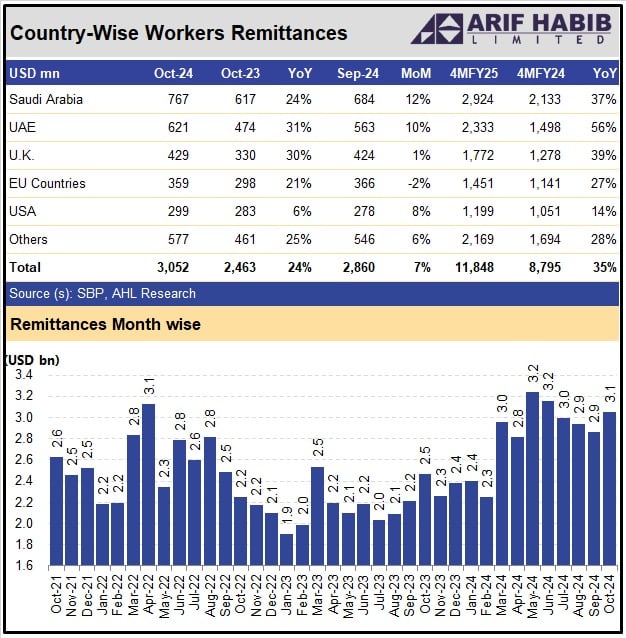
A breakdown shows that in October 2024, Saudi Arabia was the largest contributor, with Overseas Pakistanis sending $766.7 million, marking a 12% increase from September and a 24% rise from $616.8 million in October 2023.

Inflows from the UAE rose 10% month-on-month, from $562.7 million in September to $620.9 million in October, and jumped 31% year-on-year compared to $473.9 million last October.

Remittances from the UK reached $429.5 million, a slight 1% increase from September’s $424.1 million and a 30% year-on-year rise.

The European Union saw a 2% drop in inflows, totalling $359.1 million in October compared to $365.5 million in September. Meanwhile, remittances from the US rose 8% month-on-month, reaching $299.3 million in October.

In a bid to further boost remittances, the State Bank of Pakistan (SBP) recently revised its incentive structure for banks and exchange companies, introducing both fixed and variable components to encourage higher inflows.

Remittances, which were lacklustre during 2023 due to domestic uncertainty and the disparity between official and unofficial exchange rates, have begun to recover, The News reported.

These inflows have been on the rise, with a strong rebound since March 2024, reaching an average of $3 billion per month and hitting a high of $3.2 billion in May. Healthy remittances have become crucial for Pakistan’s economy, especially given the country’s sluggish export performance.

Remittances are an important source of foreign exchange reserves for the country. A report from Insight Securities highlighted the steady growth in remittances over the last 20 years, which has helped offset the impact of the growing trade deficit and supported the balance of payments.

The increase in remittances provides livelihoods for many households and also supports domestic consumption, thereby fuelling various sectors of the economy.

Pakistan had been faced its worst economic crisis, witnessed highest-ever inflation and was on the brink of a sovereign default last summer before receiving a $3 billion bailout from the International Monetary Fund (IMF).

The successful conclusion of the nine-month IMF’s stand-by arrangement in April provided macroeconomic stability. Since then, inflation has eased, and credit ratings agency Moody’s has upgraded Pakistan’s local and foreign currency issuer and senior unsecured debt ratings to ‘Caa2’ from ‘Caa3’, citing improving macroeconomic conditions and moderately better government liquidity and external positions.

The implementation of the new larger and longer IMF loan programme is expected to ensure lasting macroeconomic stability. The current account deficit has remained under control due to an increase in foreign exchange reserves supported by strong remittances and improvement in exports.

Following the receipt of the $1.03 billion first tranche of the $7 billion loan from the IMF, the central bank’s forex reserves increased to $10.7 billion as of September 27, enough to fund more than two months of imports.


Pakistan’s remittance inflow at $2.92bn in November 2024, down 4.5% month-on-month


  • Amount 29.1% higher when compared with $2.26 billion in November 2023

BR Web Desk
December 9, 2024

Inflow of overseas workers’ remittances into Pakistan stood at $2.92 billion in November 2024, 4.5% lower when compared to $3.05 billion in October 2024, showed data released on Monday by the State Bank of Pakistan (SBP).

On year-on-year basis, remittances increased by 29.1% against $2.26 billion in the same month of the previous year.

During 5MFY25, remittances went up by 33.6% YoY to $14.8 billion as compared to $11.1 billion in 5MFY24.

Home remittances play a significant role in supporting the country’s external account, stimulating Pakistan’s economic activity as well as supplementing the disposable incomes of remittance-dependent households.

Finance Minister Muhammad Aurangzeb said last week the inflow of workers’ remittances is expected to hit an all-time high of $35 billion in the current fiscal year 2024-25, compared to $30.25 billion registered in FY24.

Breakdown of remittances

Overseas Pakistanis in Saudi Arabia remitted the largest amount in November 2024 as they sent $729.2 million during the month. The amount was down 5% on a monthly basis, but 34% higher than the $543.6 million sent by the expatriates in the same month of the previous year.

Inflows from the United Arab Emirates (UAE) marginally decreased by 0.25% on a monthly basis, from $620.9 million in October to $619.4 million in November. On a yearly basis, remittances jumped over 50%, as compared to $411.8 million reported in the same month last year.

Remittances from the United Kingdom amounted to $409.9 million during the month, down by 4.6% compared to $429.8 million in October 2024. YoY inflows from UK improved by 20%.

Meanwhile, remittances from the European Union decreased by 10% MoM as they amounted to $323.1 million in November 2024, as compared to $359.1 million in October.

Overseas Pakistanis in the US sent $288.2 million in November 2024, a MoM decrease of 4.3%.

In October this year, the SBP, to enhance the flow of home remittances, revamped the incentive structure for banks and Exchange Companies (ECs). Under the system, both banks and ECs will receive two types of incentives – Fixed Component Incentives and Variable Component Incentives.
 
Remittances from overseas Pakistanis ($14.76bn in July-November 2024) have now become the largest source of non-debt foreign exchange inflows, surpassing goods exports. However, escalating political turmoil in the Middle East, triggered by the fall of Bashar al-Assad’s regime in Syria and an immediate Israeli incursion along the Syrian border, presents grave concerns.

With over 55pc of Pakistan’s remittances originating from Gulf Cooperation Council countries, it would be optimistic to assume that these inflows will remain unaffected if military escalation spreads to countries like Saudi Arabia or the United Arab Emirates. Any disruption in these key remittance corridors would significantly impact Pakistan’s foreign exchange inflows.

The situation also hinges on how the incoming administration of US President-elect Donald Trump, set to take office on January 20, 2025, handles this crisis. (Remittances in November were already lower by 4.55pc than in October).
 
Remittances from overseas Pakistanis ($14.76bn in July-November 2024) have now become the largest source of non-debt foreign exchange inflows, surpassing goods exports. However, escalating political turmoil in the Middle East, triggered by the fall of Bashar al-Assad’s regime in Syria and an immediate Israeli incursion along the Syrian border, presents grave concerns.

With over 55pc of Pakistan’s remittances originating from Gulf Cooperation Council countries, it would be optimistic to assume that these inflows will remain unaffected if military escalation spreads to countries like Saudi Arabia or the United Arab Emirates. Any disruption in these key remittance corridors would significantly impact Pakistan’s foreign exchange inflows.

The situation also hinges on how the incoming administration of US President-elect Donald Trump, set to take office on January 20, 2025, handles this crisis. (Remittances in November were already lower by 4.55pc than in October).

If military action reaches Saudi and UAE, I would argue remittences may be the least of Pakistan's problems....
 
here we find, Remittances to India nearly match with Population Ratio of Pakistan, as below :coffee:

.
=>
Remittances to India -- the second largest source of external financing after service exports -- are projected to grow at 3.7 per cent to USD 124 billion in 2024 and at 4 per cent to reach USD 129 billion in 2025, the Economic Survey said on Monday. India's primary source of remittances is oil-exporting countries. :coffee:

https://economictimes.indiatimes.co...ofinterest&utm_medium=text&utm_campaign=cppst
 

Users who are viewing this thread

Back
Top