There is already practical examples of heli-borne assaults to cross these large rivers and form bridge-heads to support water-borne reinforcements, or even bring in waves of reinforcements into these bridge-heads by air.
A defender cannot depend on the passive use of these waterways, but has to engage with the topography to mount counter-attacks. That, too, counter-attacks against flexible, air-borne assaults.
For that kind of 'Dutch' defence, the check-dams and embankments have to be in place. Consider that these structures take decades to build; that points to a vulnerability theoretically until 2035. Is there a defence prepared that takes this into account?
Nobody will use motor-boats or country boats to advance into Bangladesh. This is a good precaution to take, and neutralises an inexpensive way of movement across water obstacles, but it is essentially cancellation of a possible entry route, not sealing of possible entries. Meaning that there will be other ways of crossing even if water-borne crossings are made impossible.
Good points, but consider the following:
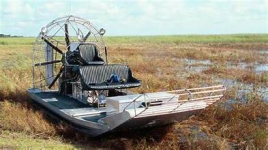
Such shallow-draught water-craft are easily available, and are cheap. They are obviously not intended for mass transfer of troops but for special ops., and penetration.
Wait, there's more.
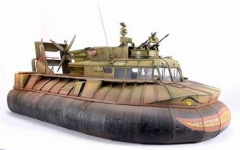
ACVs can be patrol craft mounted with machine guns up to 0.50 calibre, or wire-guided missiles, or rockets.
ACVs can also be used for troop transport for a platoon at a time, and together several can support a battalion or more advancing into the defenders' soft underbelly, where nothing is suspected to happen, because the terrain is too difficult to travers.
The defender will undoubtedly use MANPADs, used in an unconventional manner, against boats rather than against armour. Will they themselves be able to move fast enough to avoid being left struggling to progress in the mangrove swamps while the offensive goes by at an unstoppable pace?
Does the defender have enough military budget to buy expensive gear?
Will be effective against displacement vessels, will not affect ACVs or propeller craft.
There will always be the calculus of the loss of crops during the creation of such bio-barriers.
If known installations have not been spotted and mapped, then the attacker may be able to zero in on sensitive locations without difficulty.
The Sundarbans have been discussed. It now remains to consider the Chittagong and further north hill tracts and their defences.
Quite clearly, there is possible either the American style of removing the jungle then fighting a normal battle. It is unlikely that Bangladesh has opponents capable of removing forest cover. Guerilla warfare is perfectly feasible for the defender, and it will be counter-productive to spend money on useless shiny metal toys, rather than on trained soldiers trained in jungle-craft.
Creating defensive positions is a misleading term. If the suggestion is of creating trenches and bunkers, it is a very bad one. The weaker opponent, and in this case, the defender, will have to stay mobile, very mobile, to succeed against a more heavily armed attacker.

So far, we see that there is scope only for light infantry, with very heavy squad level firing authority for firing power.
There is little point in adding armour, Infantry Fighting Vehicles, or troop carriers of any description. However, ACVs and rotary wing aircraft will remain relevant, especially for lightly armed troops.
Five more separately.


yall always had superiority in numbers in this region.


 Nowhere does it say where they are holding positions. Both sides encroached on lands are staying there. You can hope Chinese comes to save you or even engage with you but the reality is you offer nothing of worth a mention. Your entire argument is a giant cope of an irrelevant state who found a mention in the evening news in CNN. Ride the wave while you can lol