Navigation
Install the app
How to install the app on iOS
Follow along with the video below to see how to install our site as a web app on your home screen.
Note: This feature may not be available in some browsers.
More options
Style variation
You are using an out of date browser. It may not display this or other websites correctly.
You should upgrade or use an alternative browser.
You should upgrade or use an alternative browser.
US Economy - News, Updates and Discussion
- Thread starter Get Ya Wig Split
- Start date
More options
Who Replied?


RabzonKhan
Trusted Member


US job openings rise above 8.1 million in May: JOLTS data
Madison Mills and Brad SmithTue, Jul 2, 2024, 7:18 AM PDT
Job openings rose to 8.14 million in the month of May, according to the latest JOLTS data (Job Openings and Labor Turnover Survey) from the US Bureau of Labor Statistics, outpacing economist expectations of nearly 7.95 million.
Catalysts Hosts Madison Mills and Brad Smith crunch the number on the fresh labor data, looking to lay off rates and the revision to April's JOLTS print.
For more expert insight and the latest market action, click here to watch this full episode of Catalysts. Source
RabzonKhan
Trusted Member
Tom Lee stands out as my favorite financial analyst and strategist because of his deep understanding of market dynamics and inventive investing ideas. He has continually showed the ability to understand trends and provide smart forecasts.
Fundstrat's Tom Lee on 6,000 S&P 500 year-end target: Setup into year-end has a lot of tailwinds
RabzonKhan
Trusted Member
National retailer raises minimum wage to $19.25 an hour
Oct. 07, 2024By Leada Gore | [email protected]
A national retailer is the latest to raise its minimum hourly wage.
Effective Oct. 1, Hobby Lobby raised its minimum full-time hourly wage to $19.25 an hour. The increase is the 13th minimum wage boost by the craft store chain in the last 15 years.
“A pillar of our success is taking care of our employees,” Hobby Lobby founder and CEO David Green said in a statement. “For decades, we have closed our stores on Sundays, and at 8 p.m. the rest of the week, to help employees balance their work and personal lives, and have time for rest, family, and worship. We work hard to provide some of the best wages and benefits in retail, which allows us to attract and retain a great team of associates to serve our loyal customers.”
The chain also offers medical, prescription and dental plans, 401(k) with company match, flexible spending plan, long-term disability benefits, life insurance, vacation pay, sick and personal leave, holiday pay, chaplain services and employee discounts.
Founded in 1972, Hobby Lobby operates 1,035 stores across the U.S.
Hobby Lobby is the latest chain to boost minimum wage in an effort to attract and retain employees. Last month, grocery chain Aldi announced it was hiring 13,000 workers while boosting its average hourly wage to $23. Target also boosted its starting wage from $15 to $24 an hour depending on position and requirements.
If you purchase a product or register for an account through a link on our site, we may receive compensation. By using this site, you consent to our User Agreement and agree that your clicks, interactions, and personal information may be collected, recorded, and/or stored by us and social media and other third-party partners in accordance with our Privacy Policy.
RabzonKhan
Trusted Member
Mexico Wants to Curb Chinese Imports With Help From U.S. Companies
Government seeks to strengthen domestic supply chains amid rising trade tension between Washington and Beijing
By Santiago Pérez WSJ Oct. 8, 2024MEXICO CITY—Mexico wants to reduce its dependence on imports from China and is asking some of the world’s biggest manufacturers and tech firms operating in the country to identify Chinese products and parts that could be made locally.
The administration of leftist President Claudia Sheinbaum, who took office last week, wants U.S. carmakers and semiconductor manufacturers as well as global giants in the aerospace and electronics sectors to substitute some goods and components manufactured in China, Malaysia, Vietnam and Taiwan, said Deputy Trade Minister Luis Rosendo Gutiérrez.
“We want to focus on supporting our domestic supply chains,” Gutiérrez said in an interview. Talks with foreign companies have been informal, he said.
The proposed measures will be focused primarily on China, Mexico’s longstanding rival in the global race to attract investment in manufacturing, Mexican consulting firm Empra said in a note to investors on Friday.
“The atmosphere in the U.S. has changed, there is a new consensus regarding greater protectionism,” said a government presentation seen by The Wall Street Journal that outlines some of Mexico’s trade and industrial priorities. “We are facing a trade war between the U.S. and China.”
China’s Foreign Ministry said in a statement to The Wall Street Journal: “Bilateral trade and cooperation between Mexico and China have brought tangible benefits to the people of both countries…Both sides should create favorable conditions for normal economic and trade interactions, as well as jointly maintain the stability of the global supply chain.”
The initiative comes as the Sheinbaum administration gears up for a review of the U.S.-Mexico-Canada Agreement in 2026. Consultations on the trade pact are set to begin in the second half of 2025, according to the document.
The talks among the three North American trading partners are expected to be more complex than in 2018 when the USMCA was signed to replace its forerunner Nafta, according to the presentation. Subjects to be discussed are expected to include trade with China and requirements for increased North American content in goods imported tariff-free into the U.S.
U.S. legislators and industry groups have raised concerns about China using Mexico as a back door to circumvent U.S. import tariffs. Mexican officials say that there is no evidence supporting such claims. “Mexico isn’t a springboard from Asia to the U.S.,” Gutiérrez said.
Chinese high-tech goods have flooded the global economy this year. The U.S. and Canada imposed tariffs on imports of Chinese electric vehicles, steel and aluminum to protect domestic manufacturing. Chinese officials have said that the country’s electric vehicles, solar panels and other products are simply better and cheaper than those made in the West.
“This isn’t an issue about China, but rather about the evolution of the Mexican economy,” said César Fragozo, executive vice president of China Chamber Mexico, a binational industry group that represents Chinese companies in Mexico and Mexican exporters to China.
Whereas 15 years ago, Mexico imported cheap finished goods from China such as toys, now it brings in billions of dollars of sophisticated components for various industries, he said.
“We believe that it’s positive for Chinese firms to establish themselves in Mexico or to have co-investments with Mexican companies, and we agree that more domestic products should be purchased,” Fragozo said.
Mexico continued to expand its exports to the U.S. under the USMCA, and in 2023 it overtook China as the biggest foreign supplier of goods to the U.S., largely as trade disputes caused China to lose market share. But Mexico has struggled to attract new foreign investment from companies aiming to move production out of China in a process known as nearshoring.
China’s exports to Mexico have also risen steadily in recent years to reach 20% of total imports, according to Mexican government data. About 70% of Mexico’s imports from Asia, primarily Chinese goods and components, are brought in by about 50 foreign companies operating in Mexico, Gutiérrez said. Half of them are U.S. firms in the automotive, semiconductor and aerospace industries.
Mexico’s government initiative also aims to reduce the risk of supply-chain disruptions and take advantage of Mexico’s proximity to U.S. markets, he said.
“While this needs to make sense case by case, substituting Chinese imports with Mexican inputs strengthens a more integrated North American trade network,” said Pedro Casas Alatriste, general director of AmCham Mexico, the industry group that represents more than 1,400 U.S. firms operating in Mexico. The initiative can also boost competitiveness by ensuring a reliable supply chain for U.S. manufacturers and enhance North America’s position in the global economy, he said.
One person familiar with the government’s plan said that some companies haven’t agreed to any specific goal around import substitution and that discussions are part of the Economy Ministry’s aspirations to strengthen domestic supply chains in key sectors such as the semiconductors industry.
Another executive at one of the firms approached by Mexican authorities said there is one big challenge: Mexico lacks basic infrastructure to substitute some high-end Chinese goods and components. That includes securing enough water and electricity to power up industrial parks.
It can also take decades for Mexico to develop local supply chains, said Jorge González Henrichsen, co-chief executive of the Nearshore Company, which helps foreign manufacturing firms operate in Mexico through its network of 16 industrial plants.
“On paper, import substitution sounds great. But execution is a big question mark, given the vast resources and specialized skill sets needed and the time it would take,” he said.
Since the signing of Nafta three decades ago, Mexico’s industrial sector has been radically transformed. Its low-wage assembly plants known as maquiladoras paved the way for the emergence of manufacturing hubs that made the country one of the world’s top exporters of vehicles, beer and flat-panel televisions.
But in the manufacturing of high-definition TV sets, for example, Mexico makes the low-value packaging and molded plastic or metal casings, while the priciest parts such as the thin glass panels are made in Asia.
“Mexico, like North America, needs to produce more than it consumes, as we are relying too much on basic products from China for our homes,” Mexico’s Finance Minister Rogelio Ramírez de la O said earlier this year. He was recently ratified in his post by Sheinbaum.
“Mexico has to do its own review because we buy $119 billion of goods a year from China and sell $11 billion to them,” he said.
RabzonKhan
Trusted Member
Goldman Sachs beats on profit and revenue as stock trading and investment banking boost results
Hugh Son Oct 15 2024
Goldman Sachs topped estimates for third-quarter profit and revenue on strong results from its stock trading and investment banking operations.
Here’s what the company reported:
======================================
Bank of America tops estimates on better-than-expected trading revenue
Hugh Son Oct 15 2024
Bank of America topped analyst estimates for third-quarter profit and revenue on better-than-expected trading results.
Here’s what the company reported:
=====================================
Citigroup earnings top estimates, boosted by investment banking
Jesse Pound Oct 15 2024
Here’s what the company reported compared with what Wall Street analysts surveyed by LSEG were expecting:
Hugh Son Oct 15 2024
Goldman Sachs topped estimates for third-quarter profit and revenue on strong results from its stock trading and investment banking operations.
Here’s what the company reported:
- Earnings: $8.40 per share vs. $6.89 LSEG estimate
- Revenue: $12.70 billion vs. $11.8 billion estimate
======================================
Bank of America tops estimates on better-than-expected trading revenue
Hugh Son Oct 15 2024
Bank of America topped analyst estimates for third-quarter profit and revenue on better-than-expected trading results.
Here’s what the company reported:
- Earnings: 81 cents vs. 77 cents LSEG estimate
- Revenue: $25.49 billion vs. $25.3 billion estimate
=====================================
Citigroup earnings top estimates, boosted by investment banking
Jesse Pound Oct 15 2024
Here’s what the company reported compared with what Wall Street analysts surveyed by LSEG were expecting:
- Earnings per share: $1.51 vs. $1.31 expected
- Revenue: $20.32 billion vs. $19.84 billion expected
RabzonKhan
Trusted Member
Guess What Percent Of Households Have Over $1 Million? You Might Be Shocked By The Number Of Millionaires
Ivy GraceMon, October 14, 2024
Many people dream of joining the millionaire club and that dream has become a reality for many Americans.
According to the Federal Reserve's latest data from the end of 2022, the number of millionaire households in the U.S. is rising – and it's not just inflation making the numbers look bigger. Even when adjusting for inflation, the percentage of households with a net worth of at least $1 million surged from 2019 to 2022 after being relatively flat for nearly two decades.
So, just how many millionaires are out there? According to the Federal Reserve's 2022 survey, approximately 18% of U.S. households had at least seven figures net worth. That's roughly 23.7 million millionaire households across the country. And with the stock market and real estate values performing strongly since then, even more households will likely join the ranks of millionaires in 2024.
While these numbers are exciting, they also come with some interesting insights into building that kind of wealth. Millionaire households share certain characteristics that offer clues for boosting their net worth.
Most millionaires don't fit the luxury-laden stereotype. Many built their wealth through disciplined saving and investing, often in employer-sponsored retirement accounts like 401(k)s. Roughly 70% of millionaires accumulated their wealth this way and a surprising 73% have never carried a credit card balance. The majority aren't high earners either – most didn't hit six-figure salaries during their careers.
According to MillennialMoney, most millionaires are 60-79 years old, which shows that it takes time for most people to accumulate wealth.
Real estate also plays a big role, with primary residences contributing about 32% of a typical millionaire's net worth. Millionaires also prioritize education, with over 60% holding a degree from public universities and only 8% from Ivy League schools.
Another characteristic is saving. Millionaires often live below their means and prioritize saving over spending. This discipline helps them build up their assets while avoiding lifestyle inflation – the temptation to spend more as income rises.
Many millionaires also have multiple streams of income. Whether through investments, side businesses or diversified career paths, they don't rely on a single source of earnings.
What Does This Mean for You?
While these habits may serve as a road map, wealth-building isn't a one-size-fits-all process. If you're aiming for millionaire status, consulting a financial advisor can help you craft a strategy that fits your lifestyle and goals. A pro can guide you in picking investments that align with your risk tolerance and financial timeline – because, let's face it, the road to a million is smoother with some expert advice along the way.
2024 Benzinga
RabzonKhan
Trusted Member
Ranked: Top 10 Countries by Value of All Their Natural Resources
By Bruno Venditti November 7, 2024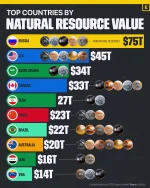
Ranked: Top Countries by Natural Resource Value
This was originally posted on our Voronoi app. Download the app for free on iOS or Android and discover incredible data-driven charts from a variety of trusted sources.Natural resources are the backbone of modern manufacturing, necessary to produce everything around us.
According to 2021 data from Statista, 10 countries dominate the global natural resource landscape, each holding vast reserves critical for various industries.
The United States ranks second, with an estimated $45 trillion in natural resources, including coal, timber, natural gas, and valuable metals like gold.
RabzonKhan
Trusted Member
Mapped: U.S. State Economies Compared to Entire Countries
By Pallavi Rao November 5, 2024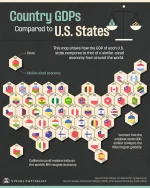
Mapped: U.S. State Economies Compared to Entire Countries
This was originally posted on our Voronoi app. Download the app for free on iOS or Android and discover incredible data-driven charts from a variety of trusted sources.Much like how the world has a few big economic players that dwarf the rest, so too does America’s $29 trillion economy.
To put this unequal distribution in perspective, this map compares U.S. state economies by their gross domestic product (GDP) to that of a similarly-sized country.
State GDP data is sourced from the Bureau of Economic Analysis, the latest available for the year 2023. Meanwhile, country GDP data from the International Monetary Fund, last updated October 2024.
Users who are viewing this thread
Total: 2 (members: 1, guests: 1)
Pakistan Defence Latest
-
-
 KP govt backs out of counterterrorism commitments during talks: Naqvi (7 Viewers)
- Latest: hydrabadi_arab
-

-
Country Watch Latest

Latest Posts
-
-
 Makkah Defence Alliance: Turkey, Saudi Arabia, and Pakistan, news & updates (63 Viewers)
- Latest: Yasser76
-
KP govt backs out of counterterrorism commitments during talks: Naqvi (7 Viewers)
- Latest: hydrabadi_arab
-

-
