US Economy - News, Updates and Discussion

A little opinion on Trumponomics 2.0:

The course of trade relations with China will probably follow the trend of the last 8 years, which has been a deterioration of relations: each new president has been many times worse for China than the previous one.

Washington’s strategies: the technological and scientific blockade of microchips and the sanctions policy will continue. If Rubio becomes Secretary of State, China will face a barrage of sanctions on the entire spectrum of political issues.

China faces the prospect of a reduction of perhaps 30-50% in its external trade surplus due to tariffs. In response: the depreciation of the yuan is directly proportional to the reduction in trade turnover and the positive balance between China and the United States and Europe. In other words, from 2025 to 2029, the yuan could depreciate by 30-50%. This is a negative signal for all yuan reserves.

Since taking office, Trump is likely to impose 60% tariffs on Chinese exports, combined with retaliatory measures, and official trade volume will fall from $650 billion to $100 billion. China’s largest trading partner will be Japan, with Korea and Russia in second and third place. In fact, China will continue to supply another $200 billion through third countries. The EU will start to adopt a less radical policy towards Chinese goods, and part of US exports will be redirected there. The total losses from Trump’s tariffs for China will be around $300 billion in surplus – 30 to 50%.

Second measure: increasing the share of the yuan in foreign trade - a measure that contradicts the devaluation, but which will be stimulated by low prices for Chinese goods (these, in turn, by state subsidies). Now the volume of transactions in yuan in foreign trade is about 15% - it can gradually increase to 30 and even 50%. This is a critical mass for each state - for the Middle East and Africa, for example, where the choice between the yuan and the dollar will become an advantage. And it will spread to the political plane. A demarche in yuan is possible in Europe - for example, in Italy, Germany, France. Trump does not mind, even if they switch to the rupee.

In general, the devaluation is a critical break in the tacit agreements between the US and China. In general, Trump's second term - its main result is the complete withdrawal of China and the United States from the agreements of the 1990s - both in the economy and in politics.

Pros for China: Trump will not be heard in the EU, and Trump will not make new environmental demands on Beijing. Perhaps even new agreements on the fuel and energy complex (oil, LNG, nuclear) will emerge as payment for Trump's restraint: China will be able to increase purchases of American hydrocarbons.

The war for the creation of the AI industry will continue. China will probably impose export controls on the supply of almost all rare earth metals and lithium products to the United States, the technological transition will become very expensive for the United States, and it will “fight” with China for the mineral resource base in third countries.

Joint ventures between China and the United States will go to third countries, as during Trump's first term: Taiwan, South Korea, Vietnam, Indonesia, Thailand, Mexico.

If the war in Taiwan does happen, Trump will not be against expanding the overland supply of Chinese goods to Europe through Russia. The likelihood of a crisis in Central Asia is increasing.

In terms of taxation:

A tax reform as favorable or more favorable than the one he approved in 2017 would be expected, the TCJA will expire in 2025, so, with the Republican Congress in control, they can approve an even better reform than the one he carried out in 2017.

Furthermore, a profound deregulation in the economy is expected, removing obstacles to innovation, which is also an important additive to an economic boom.
 

Trump to unleash nearly 40% tariffs on China in early 2025, hitting growth: Reuters poll

Story by Vivek Mishra and Kevin Yao. 11/20/24

BENGALURU/BEIJING (Reuters) - The United States could impose nearly 40% tariffs on imports from China early next year, a Reuters poll of economists showed, potentially slicing growth in the world's second-biggest economy by up to 1 percentage point.

The poll, the first on China's economy by Reuters since Donald Trump's sweeping election victory on Nov. 5, also predicts that the President-elect will resist starting off with blanket 60% tariffs on Chinese goods.

Trump, who is due to take office in January, pledged during campaigning to slap hefty tariffs on Chinese imports as part of a package of "America First" trade measures, causing unease in Beijing and heightening growth risks for China.

Not only are the threatened tariff rates much higher than the 7.5%-25% levied on China during his first term, the economy is also in a much more vulnerable position given the prolonged property downturn, debt risks and weak domestic demand.

A poll of more than 50 economists by Reuters from Nov. 13-20 showed a strong majority, both in and outside mainland China, expects Trump to impose the tariffs by early next year, with a median estimate of 38% and projections ranging from 15% to 60%.


Most respondents said they do not expect blanket 60% tariffs on Chinese goods in early 2025 as this could accelerate inflation within the United States.

"We expect the new U.S. administration to bring back the original plan of Trump 1.0," ANZ's chief economist Raymond Yeung said, estimating that the average tariff on Chinese goods could be raised by 32–37%.

Chinese policymakers, who have ramped up stimulus to spur growth since late September, face increased pressure next year to spur domestic demand to offset an expected drop in exports - a key growth driver this year, analysts say.

On the potential impact on China, the poll predicted that new U.S. tariffs would reduce China's 2025 economic growth by around 0.5-1.0 percentage point.

For now, however, most of the economists polled have maintained their median growth forecasts for this year and 2025 at 4.8% and 4.5%, respectively, consistent with projections made before the U.S. elections. Growth is expected to slow further to 4.2% in 2026.

They are awaiting the Trump administration's China trade policies, which could lead to potential downgrades in their outlooks.

"Exports will be a key pillar of growth as global demand holds up, though new U.S. tariffs could shave up to 1 percentage point off GDP growth," said Mo Ji, chief China economist at DBS.

"Consumption will remain lacklustre due to wealth effects from falling property prices and rising unemployment.
Infrastructure investment will drive a moderate fixed asset investment recovery, though private investment lags." Read more
 
Under the leadership of the United States, it is encouraging to observe an increasing number of countries recognizing China's export dumping scam.


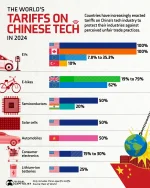
Which Countries Are Putting Tariffs On China’s Tech?

By Kayla Zhu December 11, 2024
image.webp

Global Tariffs On China’s Tech Industry​

This was originally posted on our Voronoi app. Download the app for free on iOS or Android and discover incredible data-driven charts from a variety of trusted sources.

Countries worldwide have been increasingly imposing tariffs on China’s tech industry to address concerns over economic dependence, national security, and market fairness.

These actions reflect a broader trend of escalating trade measures affecting the global tech landscape.

This chart shows China-specific tariffs imposed by countries on products from China’s tech sector. This does not include other general tariffs which may also apply to Chinese products.

The data comes from Rest of World and is updated as of November 2024.

Tariffs have gained renewed focus ahead of President-elect Donald Trump’s second term, and his pro-tariff agenda.

The Biden administration hasn’t shied away from trade measures against China either. In May 2024, the U.S. raised tariffs on Chinese-made electric vehicles from 25% to 100%–as well as several other products–citing concerns over manufacturing overcapacity and its impact on global markets.

Four countries or regions, including the U.S., have specific tariffs targeting China’s electric vehicle industry, which is quickly skyrocketing in market share with exports surging 13,300% to $42 billion in 2023. China currently accounts for nearly 70% of global EV production.

China’s EV industry success is driven by comprehensive government support, including manufacturer subsidies, a massive domestic market, and vertical integration in the supply chain.

The EU’s recent tariff action on Chinese electric vehicles was prompted by the industry’s rapid growth, with its market share rising from 3.9% to 25% between 2020 and 2023, fueling concerns about the future of European automotive jobs and industry sustainability.
 

US consumer spending rises in November; monthly inflation benign

Story by Reuters 12/20/24
By Lucia Mutikani

WASHINGTON (Reuters) -U.S. consumer spending increased in November amid strong demand for a range of goods and services, underscoring the economy's resilience, which saw the Federal Reserve this week projecting fewer interest rate cuts in 2025 than it had in September.

There was also good news on inflation last month after a series of warmer readings. The report from the Commerce Department on Friday showed moderate monthly rises in prices, with a measure of underlying inflation posting its smallest gain in six months. Still, some areas of stickiness remain.


"The economy continues to grow from strong consumer demand as income growth and the wealth effect from higher portfolio values give consumers capacity to spend," said Jeffrey Roach, chief economist at LPL Financial. "Inflation was more benign than expected but the stickiness of some categories supports the Fed's hesitancy to materially lower rates next year."

Consumer spending, which accounts for more than two-thirds of U.S. economic activity, rose 0.4% last month after a downwardly revised 0.3% gain in October, the Commerce Department's Bureau of Economic Analysis reported.

Economists polled by Reuters had forecast consumer spending advancing 0.5% after a previously reported 0.4% rise in October.

The nearly broad-based increase in spending was led by new motor vehicles, likely in part as households replaced vehicles damaged during Hurricanes Helene and Milton.

Spending on recreational goods and vehicles also rose as did outlays on financial services and insurance.

There was also increased spending on recreation services, healthcare, clothing and footwear, furniture as well as housing and utilities. Spending at restaurants and bars as well as on hotel and motel stays also increased.

When adjusted for inflation, consumer spending rose 0.3% after edging up 0.1% in October.

Robust consumer spending helped to propel the economy to a 3.1% annualized growth rate in the third quarter after a 3.0% pace of expansion in the April-June quarter.

Economists are expecting only a modest slowdown in consumer spending this quarter after it surged at a 3.7% pace in the July-September quarter, the fastest in 1-1/2 years. The Atlanta Fed is currently forecasting gross domestic product increasing at a 3.2% rate in the fourth quarter.

Fed Chair Jerome Powell on Wednesday described the economy as having "just been remarkable," adding "I feel very good about ... the performance of the economy and we want to keep that going."

The U.S. central bank on Wednesday cut its benchmark overnight interest rate by 25 basis points to the 4.25%-4.50% range. It forecast only two rate reductions in 2025, in a nod to the economy's continued resilience and still-high inflation. Read more
 

Here’s the ‘big story’ from 2024 economy​


To view this content we will need your consent to set third party cookies.
For more detailed information, see our cookies page.
 
The United States, a controversial country, is ruled by 3 opportunistic corporations.

To view this content we will need your consent to set third party cookies.
For more detailed information, see our cookies page.
 

Here’s the ‘big story’ from 2024 economy​


To view this content we will need your consent to set third party cookies.
For more detailed information, see our cookies page.

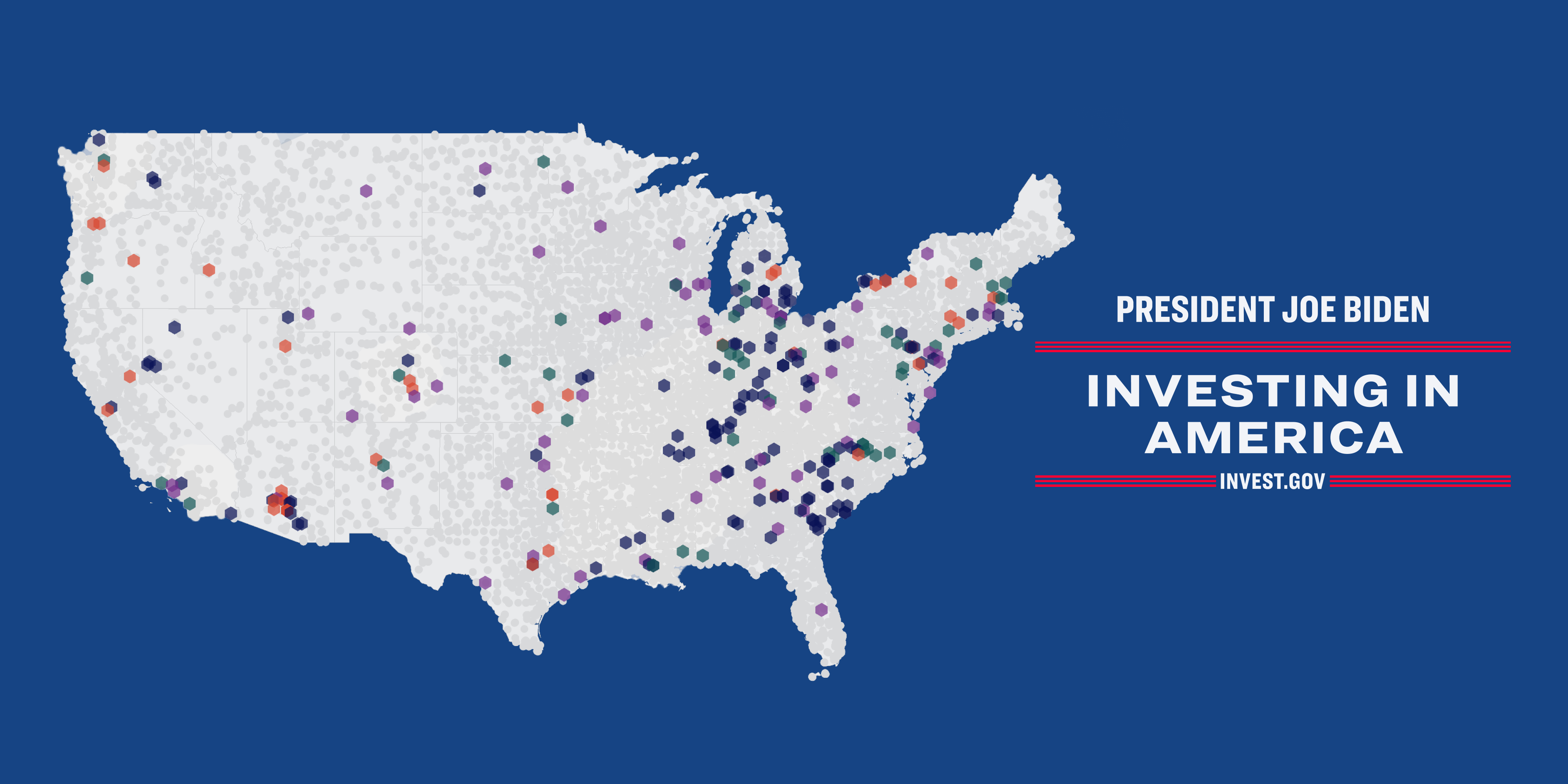
The internal problems of the US are more political than economic. In economic terms, the US is doing well, investing more than US$200 billion per year in manufacturing infrastructure, and has been growing since 2021. From 2020 to 2023, the US jumped from a GDP of US$21 trillion to US$27 trillion. In the same period, China went from US$14 trillion to US$17 trillion. The US invested US$400 billion in industrial infrastructure between 2023 and 2024. “Manufacturing the Future Under the Biden-Harris Administration, private companies have announced $910 Billion so far in commitments to invest in 21st century industries like:

$395B
Semiconductors & Electronics

$177B
EVs & Batteries

$82B
Clean Energy Manufacturing & Infrastructure

$42B
Biomanufacturing

$47B
Heavy Industry

$167B
Clean Power”

Investing in America
$582.8 Billion in public infrastructure, semiconductor and clean energy investments in the United States under the Biden Administration, including:

$323.4B
announced for transportation investments in roads, bridges, public transit, ports and airports, as well as electric school and transit buses, EV charging, and more.

$78.6B
announced for grants, rebates, and other initiatives to accelerate the deployment of clean energy, clean buildings, and clean manufacturing. This is not inclusive of the clean energy tax incentives from the Inflation Reduction Act.

$26.4B
announced to make our communities more resilient to climate change and other threats.

$38B
announced to provide clean water across the United States and improve water infrastructure. This includes $8.9B dedicated to lead pipe and service line replacement.”
.
Just look at the map and check all public and private investments.

There is a revolution underway in the USA. The investment in manufacturing structure (https://fred.stlouisfed.org/series/TLMFGCONS) will be US$240 billion in 2024 (it was US$80 billion before the pandemic) and in 2023 it was US$210 billion. And the gap between US and Chinese GDP is widening (https://data.worldbank.org/indicator/NY.GDP.MKTP.CD?end=2023&locations=US-CN&start=2018) – not narrowing – after the Pandemic.
 
So Biden and Democrats semingly dragged the US out lf a recesseion and delivered strong economic figures. Yet Trump repeatedly says US economy is gone manure and eventually win the election.
 
Washington State will lead the way forward by raising its minimum wage to $16.66 per hour, the highest in the Nation. This landmark decision demonstrates the state's consistent commitment to its employees, ensuring that they are adequately compensated for their hard work and dedication.

The state is boldly hiking the minimum wage to reduce income disparity and empower the most vulnerable.

As a proud Washingtonian, I celebrate this achievement with joy and optimism.


These states will raise the minimum wage in 2025

Ten states will offer a minimum wage of $15 an hour or higher.

ByMax Zahn
December 31, 2024

Nearly half of U.S. states are set to raise their minimum wage at the outset of 2025, boosting pay for millions of workers stretching from California to Maine.

In all, 21 states will raise their wage floors on Jan. 1 in keeping with inflation-adjusted increases or as part of scheduled hikes that take effect at the beginning of each calendar year.

The pay increases will affect about 9.2 million workers, who will gain a combined $5.7 billion over the course of 2025, according to the left-leaning Economic Policy Institute, or EPI.

After the wave of wage hikes, Washington will become the state with the highest minimum wage, offering workers $16.66 per hour. Workers in California and New York will enjoy the second-highest wage floor, as both states implement a minimum hourly wage of $16.50.

Pay increases set to take hold in the new year will bring the wage floor to $15 an hour or higher in Washington, D.C., as well as 10 states, among them Delaware, Illinois and Rhode Island. Those areas play host to one of every three U.S. workers, EPI found.

Overall, the states set to raise their minimum wage on Wednesday include: Alaska, Arizona, California, Colorado, Connecticut, Delaware, Illinois, Maine, Michigan, Minnesota, Missouri, Montana, Nebraska, New Jersey, New York, Ohio, Rhode Island, South Dakota, Vermont, Virginia and Washington.

The nation's highest wage floors will take effect in some of the nearly 50 cities and other localities that will impose minimum pay hikes.

Twenty-nine cities in California will see pay hikes, including a $17-an-hour wage floor that will take effect in Oakland. Seven localities in Washington will increase their minimum wage, among them the country's highest wage floor: $21.10 an hour in Tukwila.

The latest round of pay increases, however, will not affect more than a dozen states concentrated in the South that lack a minimum wage or offer a minimum wage that does not exceed the federal minimum of $7.25 per hour.

The last federal minimum wage hike took place in 2009, when Congress raised the pay floor to its current level. When adjusted for inflation, the federal minimum wage stands at its lowest level since February 1956, nearly 70 years ago, EPI found.
 

US adds Chinese tech giants to list of companies allegedly working with China’s military

Juliana Liu
By Juliana Liu, CNN. 1/7/25

Hong KongCNN —

The US Department of Defense has added Chinese tech companies Tencent, a social media and gaming giant, and CATL, the world’s largest battery maker, to a list of firms that it alleges work with China’s military.

Inclusion on the Pentagon list does not result in any immediate sanctions, but it could affect the reputations of the companies named and hinder their commercial progress, particularly if they want to do business in the United States.

Shares in Tencent, which owns Chinese super-app WeChat, were 6.5% lower in Hong Kong on Tuesday, while CATL’s Shenzhen-listed shares lost more than 3%.

They join dozens of other alleged Chinese military companies on the list that the Defense Department alleges operate directly or indirectly in the US, according to a notice posted to the Federal Register on Monday.

The Pentagon has said the so-called 1260H list, which is updated annually, is “an important continuing effort” in highlighting and countering China’s “military-civil fusion” strategy, a goal to develop the most technologically advanced military in the world by eliminating barriers between the country’s civilian research and commercial sectors and its armed forces.

In a statement to CNN, Tencent called its inclusion on the list “a mistake.”

“We are not a military company or supplier. Unlike sanctions or export controls, this listing has no impact on our business. We will nonetheless work with the Department of Defense to address any misunderstanding,” a spokesperson said.

CATL, which supplies batteries to Tesla and plans to provide its “knowledge” and services to Ford to make lithium-ion batteries at a plant in Michigan, said in a statement that it “has never engaged in any military-related business or activities, so this designation by the Department of Defense is a mistake.”


“We will proactively engage with DoD to address the false designation, including legal action if necessary,” it added.

A tech rivalry between Washington and Beijing has been escalating ahead of the inauguration of US President-elect Donald Trump later this month. Last week, Beijing said it was planning to curb the export of technology used to extract minerals critical for the growth of the global electric vehicle (EV) industry.

In December, the outgoing Biden administration imposed fresh export controls on US-made semiconductors that Washington fears Beijing could use to make the next generation of weapons and artificial intelligence (AI) systems.

The US Commerce Department said the goal of the curbs was to slow China’s development of advanced AI tools that can be used in war and to undercut the country’s homegrown semiconductor industry, which it says threatens the national security of the US and its allies. Read more
 
To view this content we will need your consent to set third party cookies.
For more detailed information, see our cookies page.
 
To view this content we will need your consent to set third party cookies.
For more detailed information, see our cookies page.
 
To view this content we will need your consent to set third party cookies.
For more detailed information, see our cookies page.
 
To view this content we will need your consent to set third party cookies.
For more detailed information, see our cookies page.
 
To view this content we will need your consent to set third party cookies.
For more detailed information, see our cookies page.
 

Users who are viewing this thread

Pakistan Defence Latest

Latest Posts

Back
Top