US Perspective on the Iran - Israel / US War

It's clear you do not nor will you attempt to understand.

Gasoline is on average 45% higher than it was prior to the start of the current conflict. Diesel fuel is even higher. You are deluding yourself if you believe there is no downstream effect on the economy. The 2026 farm outlook is showing a decline in income compared to 2025. Animal / animal product receipts are estimated to drop by 5.8%. You can expect higher meat prices as a result.

Looking at key leading economic indicators:
  1. Consumer sentiment is down.
  2. Building permits are currently down 7.63% from this time last year.
  3. Credit rating outlook is on track to be downgraded.
Another month or two of this and the Republicans can expect a bloodbath in the midterms.
I (rather, my family) have a factory in California that makes bedframes from steel pipe imported from another Chinese factory we own.

First things that's up is the steel bar (up 9%) that was shipped to my Chinese Factory (so they can be pulled into pipe), that's up because of the iron ore price up, and that's because the ore is coming from Australia to China, and that now has a bunker fuel surcharge.

Then I got charged a $1000 fuel surcharge per TEU and about 15% up on consignment for the steel pipe from Shanghai to Long Beach, then around 10% increase on consignment fee for my logistic company to truck it to my factory. And I had a 15% profit margin before the war.

Another month or two in this I would have to shut the entire factory down
 
Will the Iranians allow the US to have easier terms for surrender? Strategically the USA has lost this war in the same way the USA won lots of military victories in Vietnam, but lost the war. The USA cannot find a way out of the quagmire it finds itself in, and we all saw Rubio beg for "things to be the same before the war started.."

Why would the Iranians allow the USA to have an easier time of it ?
I understand that everyone loves to resort to the Vietnam War, but if you want to believe the US 'lost' against Iran -- go for it.

Every analogy has a breaking point, meaning when the analogy is no longer appropriate. Can YOU find the differences between Iran and Viet Nam?
 
Well, unless you are in charge of the MIC and you get a share of their profit, that's not the matter for you. I mean, how are you personally gaining from F-35 being used "brilliantly," and A-10 got reprieved?

...I had 5 relative lost their job in the last 4 months, and 14 lost their job since Jan 2026 (4 of them working in our factory in California),...

...telling them they lost their job because we don't want Iran to have nuclear weapons...
What about the people whose lives have benefited from the US-Iran War?


U.S. Gulf Coast refiners are reaping the strongest margins in years as disruptions to Middle Eastern oil flows from the Iran war raise demand for U.S. fuel exports, analysts and experts said.​

Personally, I do not believe Iran is a country that should be a nuclear weapons state. Fair? Not. But that is no different than Iran believing that the US and Israel should not exist. The difference is that one side have the power to 'do something' about it. The world is not fair, and it is about time everyone live as it is.

I am sorry that YOU are directly affected, and negatively at that. But if you ask me to look at your situation, I can make the same demand of you to look at others' situations.


America’s employers a delivered a surprising 115,000 new jobs last month despite an economic shock from the Iran war.​
Hiring was better than the 65,000 forecasters had expected, though it decelerated from the 185,000 jobs created in March. The unemployment rate remained at a low 4.3%.​

No more 'Death to America'.

But 'Death to Israel' ? Go ahead. Not because I want 'Death to Israel', but because I believe the Israelis can defend themselves. But once we hear 'Death to America', there is no telling what kind of wacko the US will have in the White House that will take that threat seriously enough to act on it, and there is no telling what kind of concessions the US want once we are done.
 
Last edited:
What about the people whose lives have benefited from the US-Iran War?


U.S. Gulf Coast refiners are reaping the strongest margins in years as disruptions to Middle Eastern oil flows from the Iran war raise demand for U.S. fuel exports, analysts and experts said.​

Personally, I do not believe Iran is a country that should be a nuclear weapons state. Fair? Not. But that is no different than Iran believing that the US and Israel should not exist. The difference is that one side have the power to 'do something' about it. The world is not fair, and it is about time everyone live as it is.

I am sorry that YOU are directly affected, and negatively at that. But if you ask me to look at your situation, I can make the same demand of you to look at others' situations.


America’s employers a delivered a surprising 115,000 new jobs last month despite an economic shock from the Iran war.​
Hiring was better than the 65,000 forecasters had expected, though it decelerated from the 185,000 jobs created in March. The unemployment rate remained at a low 4.3%.​

No more 'Death to America'.

But 'Death to Israel' ? Go ahead. Not because I want 'Death to Israel', but because I believe the Israelis can defend themselves. But once we hear 'Death to America', there is no telling what kind of wacko the US will have in the White House that will take that threat seriously enough to act on it, and there is no telling what kind of concessions the US want once we are done.
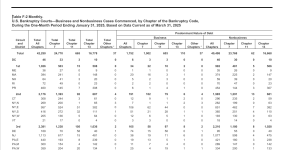
First of all, Spirit Airlines alone has taken 17000 jobs, and then you add the people and companies that had contracts with Spirit, and they would have to eventually cut jobs. If the single company collapses alone on May 2nd would bring around 20000-25000 jobless people to the market.

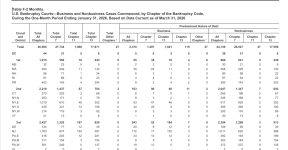
And then looks at the company filing Ch 7, 11, 13 Bankruptcy between Jan-March 2026

1778473299929.png

Compared to the same period in 2025

1778473526486.png

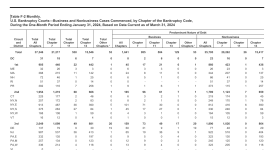
And then compare to the same period in 2024
1778473453141.png

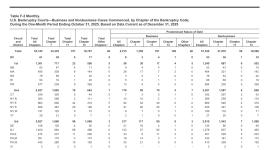
But if you think 2026 is bad? Q4 2025

1778473604447.png

https://www.uscourts.gov/data-news/reports/statistical-reports/bankruptcy-filings-statistics

There are around 180,000 bankruptcy filings in 2024, around 210,000 in 2025, and so far, we are looking at around 46k in Q1.

While that's just one side of the equation, the other is job growth, and we had seen some pretty bad numbers here in 2025


Do you think that the 110k job created is going to make a positive difference? You keep talking to me about "the people" who benefit from the war, and do you realise who those people are? And do you think any of "the people" are everyday Americans like you and me? Now what? Gas is 4.3 a gallon in oil production state like Texas. Farming had been wiped out by High Diesel price, a family member of mine told me off-road diesel (or Red Diesel) is now the same price as gas, which is close to 4 dollar, Off Road Diesel is the one you use on all your tractors and planters, and also generates electricity on the farm. Do you know how much it was before this war? $1.85/gallon. And do you know what the impact on food price if we had red diesel in $4 dollar range? You think a box of Nebraska Tomatoes is expensive now for $2.4 a pound, come back in a year when you will see it go up to $5 a pound. And don't get me started with "On Road" diesel. Do you still think that 110,000 job number (a lot of those are casual jobs by the way) and whoever benefits from this war can and will cover that?

The question is never who this war benefits; the question is always who suffers in this. I don't care, Iranian chant "Death to America," dude, when I was in Iraq, everybody did that in my face, what do you think I should do? Kill them all? And at this pace, we don't need the Iranian or Iraqi to chant "Death to America," we are doing a pretty good job by ourselves, in case you haven't noticed.
 
Last edited:
To view this content we will need your consent to set third party cookies.
For more detailed information, see our cookies page.


More of the American perspective
 
Overall, I agree with you that the US cannot free the stranded ships AND must also somehow ensure future transits are safe like before. I suspect the Chiefs already told Trump that. But I also suspect that Stump want to show that if the US can free up a few ships, for now, that will induce Iran to (re)negotiate the terms of surrender. I know that the word 'surrender' will trigger some temperaments -- do not care.

You're like Real Madrid. Absolutely impermeable to reality.
 
To view this content we will need your consent to set third party cookies.
For more detailed information, see our cookies page.


More of the American perspective


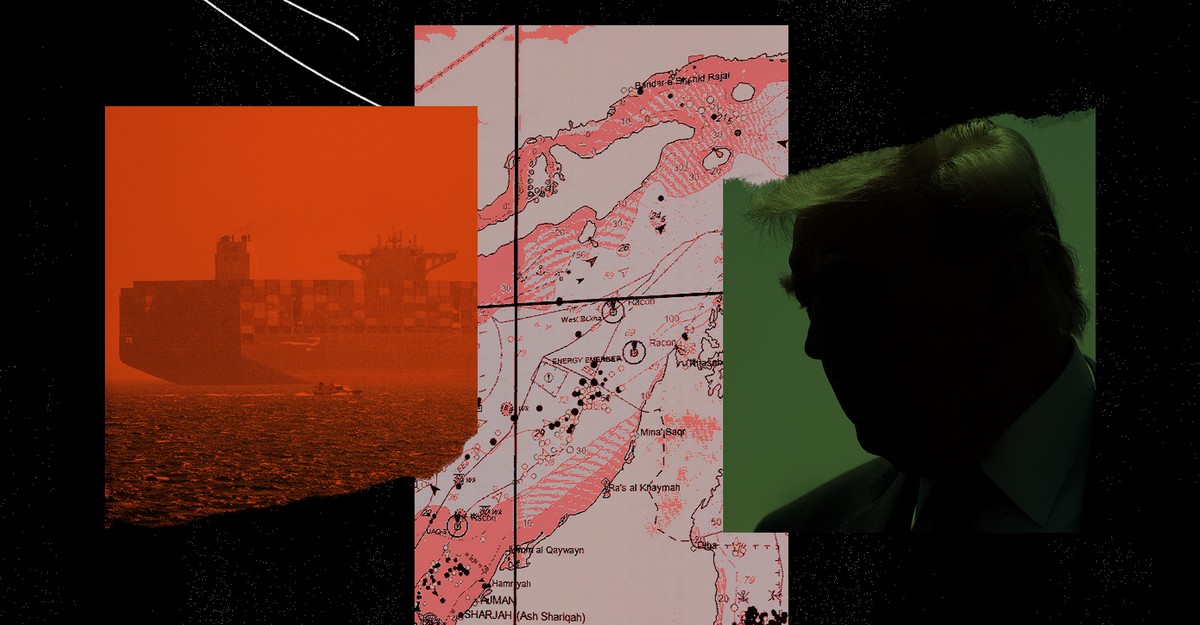
Things are bad when you have lost the right wing nut jobs at The Atlantic...
 
I had a better one. Heard it when I was actually filling my car up at a servo.

"I don't know what the fuss is all about. I am still putting $50 of fuel in my car."

Yup, heard that one before, with the tagline "Inflation? What inflation? ...... "
 
With Donald Trump due in Beijing in 3 days if the trip goes ahead, we won't see anything new military actions by Israel/USA until that is over. However, will Iran 'play up' during Trumps trip is an unknown, especially if it decides to military respond to USN military actions against its ships which they recently said they would.

The Trump trip does feel like it has all the hallmarks of a naughty child going to see the headmaster to be told off for being naughty and given corrective homework to do..
 
It's clear you do not nor will you attempt to understand.

Gasoline is on average 45% higher than it was prior to the start of the current conflict. Diesel fuel is even higher. You are deluding yourself if you believe there is no downstream effect on the economy. The 2026 farm outlook is showing a decline in income compared to 2025. Animal / animal product receipts are estimated to drop by 5.8%. You can expect higher meat prices as a result.

Looking at key leading economic indicators:
  1. Consumer sentiment is down.
  2. Building permits are currently down 7.63% from this time last year.
  3. Credit rating outlook is on track to be downgraded.
Another month or two of this and the Republicans can expect a bloodbath in the midterms.

- Q1 GDP growth at 2%
- March core retail sales at 1.9%, minimal inflation
- strong job growth in March and April
- record high energy exports
- 4 months of manufacturing expansion
- stocks flying

Higher fuel prices just haven’t had a significant effect on the economy. I’ll continue to monitor the economic data points as they come in. April retail sales are released this week
 
Who Has the Upper Hand in Iran?

One of the strangest habits in modern war analysis is how quickly survival gets confused with victory. Iran has not collapsed overnight. The regime still broadcasts threats, launches missiles and drones, and floods television and social media with declarations of imagined strength. From that surface-level reality, a growing chorus of commentators has rushed to claim that Iran has embarrassed the United States, exposed Israeli weakness, and seized control of escalation through its ability to threaten the Strait of Hormuz. Much of that analysis mistakes continued existence for strategic success and ignores nearly every measurable indicator of national power.

Wars are not scored like debates on cable television. They are judged through military capability, economic endurance, political cohesion, freedom of action, strategic leverage, and the ability to sustain power while degrading an opponent’s. By those standards, Iran is substantially weaker today than it was before the war began. The United States and Israel still hold the upper hand because the foundations of Iranian power have been systematically reduced in ways that will take years to rebuild, if they can be rebuilt at all.

The scale of military destruction alone is extraordinary. Much of the senior leadership structure that spent decades constructing Iran’s regional military network is dead.

Senior IRGC commanders, missile force leaders, intelligence officials, nuclear scientists, operational planners, and even the Supreme Leader himself have been eliminated. Mohammad Bagheri, Hossein Salami, and other senior figures who represented the institutional backbone of Iran’s military strategy are gone. Entire command relationships were shattered during the opening phases of the war, leaving surviving leaders scrambling to maintain continuity while under constant pressure.

The damage extends far beyond personnel losses. Nuclear facilities that represented decades of investment and strategic ambition now sit buried under rubble after sustained strikes on enrichment sites, underground complexes, centrifuge production facilities, research centers, and supporting infrastructure. Analysts continue to speak as though Iran can simply restart enrichment at industrial scale in a matter of months. That misunderstands what was destroyed. Advanced centrifuge production depends on precision manufacturing, specialized tooling, secure facilities, trained personnel, supply chains, and protected infrastructure. Large portions of that ecosystem no longer exist.

Iran once believed it could steadily push its nuclear and missile programs toward a threshold where the military cost of stopping them would become politically unacceptable for any outside power. That strategy shaped Tehran’s thinking for years. The regime hoped to create a fait accompli, a hardened shield of missiles, proxies, underground facilities, and enrichment capability that would eventually deter meaningful intervention. Instead, the war demonstrated that the shield was penetrable and that the consequences of crossing certain lines were far greater than Tehran anticipated.

Its missile enterprise has suffered similar devastation. Before the war, Iran had steadily expanded ballistic missile production and stockpiles as the centerpiece of its deterrent strategy.

Analysts estimated the regime could manufacture roughly one hundred ballistic missiles per month. Today many of the machine tooling centers, fuel production facilities, assembly plants, storage depots, and transport infrastructure that sustained that output are destroyed or inoperable.

Production has effectively collapsed under sustained strikes, economic isolation, cyber operations, and industrial disruption. A state can expend missiles quickly in war. Rebuilding the industrial base that creates them is a much slower process.

Iran’s naval capabilities have also absorbed severe damage. Large portions of the Iranian Navy and IRGC maritime forces were destroyed or rendered ineffective during the campaign. Tehran had invested heavily in asymmetric maritime warfare through fast attack craft, anti-ship missiles, naval mines, IRGC naval units, and swarm tactics intended to threaten global shipping. Many of those capabilities were directly targeted.

Naval staging areas, missile launch infrastructure, command facilities, and key maritime assets were destroyed in strikes specifically designed to prevent Iran from controlling chokepoints or sustaining attacks on international commerce. Iran can still create disruption. It can still threaten shipping lanes and inject uncertainty into global markets. But threatening commerce is not the same thing as commanding the sea.

The debate over the Strait of Hormuz reflects a broader misunderstanding about power itself. Many analysts point to Iran’s ability to threaten oil markets as evidence that Tehran somehow controls escalation and can ultimately force the United States and its allies into retreat. Secretary of State Marco Rubio described this dynamic accurately when he referred to Iran’s use of the Strait as an “economic nuclear weapon.” By openly threatening the world economy through coercion and instability, Iran may have accomplished the opposite of what it intended. It reinforced for regional governments and global powers why the regime can never again be allowed to hold that level of leverage unchecked.

Across the Gulf, states are already accelerating efforts to bypass dependence on the Strait through pipelines, expanded port infrastructure, and alternative export corridors. The UAE’s growing alignment with Israel reflects a wider regional shift underway. Governments that once viewed Iran as a difficult but necessary regional power increasingly see it as the primary source of instability threatening economic growth and long-term security. Tehran spent years trying to convince the region that resistance movements and proxy militias represented strength. The war has increasingly exposed them as engines of destruction that drag entire societies toward crisis.

The same flawed black-and-white thinking shapes discussion of Iran’s nuclear material and enrichment program. Some analysts insist Iran will never negotiate, never surrender enriched uranium, and inevitably race toward a bomb again the moment fighting stops. No serious strategist can predict with certainty how the regime behaves under sustained military and economic pressure. The material could ultimately be removed through negotiation, coercive diplomacy, or force. What matters strategically is that Iran has once again validated every warning that drove decades of nonproliferation concerns. The regime demonstrated how close it intended to move toward nuclear weapons capability while simultaneously funding proxy terrorism, threatening maritime commerce, and destabilizing the region through armed militias.

Iran’s air defenses and air force have also been badly degraded. Israeli and American aircraft operated repeatedly over Iranian territory after dismantling much of the country’s integrated air defense system.

Radar sites, command nodes, surface-to-air missile batteries, and air bases were systematically targeted. Iran’s air force, already aging and technologically outmatched before the war, was further devastated through losses in aircraft, infrastructure, maintenance capacity, and operational readiness. Once a country loses the ability to contest its own airspace in a meaningful way, every other vulnerability becomes magnified.

Economically, the pressure is immense. Oil exports, industrial production, energy infrastructure, shipping, and foreign investment have all suffered major disruption. Analyses from the Foundation for Defense of Democracies estimate economic losses well into the hundreds of billions when direct damage, lost production, sanctions pressure, and long-term contraction are combined. Even if the war ended tomorrow, recovery would likely take years. Sustained military destruction layered onto sanctions creates compounding effects that spread through every sector of a national economy. Inflation rises. Currency stability erodes. Capital flees. Supply chains fracture. Public frustration deepens.

Political stress inside the regime is becoming increasingly visible as well. Iranian leaders have publicly contradicted one another over retaliation, negotiations, military strategy, and relations with outside powers. That matters because authoritarian systems depend heavily on projecting unity and control. Visible disagreement signals strain throughout the governing structure. The regime has also kept internet access heavily restricted for much of its population since the war began, fearing unrest and uncontrolled information flow. Governments confident in their domestic stability rarely isolate their own citizens from the outside world during conflict.

Iran’s regional proxy network has suffered devastating setbacks. Hamas’s senior leadership and much of its military infrastructure were destroyed in the war that followed the October 7 attacks. While Hamas still exists as a political force in portions of Gaza, it no longer resembles the organization that once coordinated large-scale cross-border assaults, sustained prolonged combat operations, and relied on steady external resupply from Iran and its regional network. Its tunnel systems, weapons production capacity, command structure, and foreign support pipelines have been systematically dismantled or severely degraded. Cut off from many of its external backers and facing constant military pressure, Hamas has been reduced from a regional instrument of Iranian power projection to a battered and isolated insurgent remnant struggling to survive.

Hezbollah, long marketed as Iran’s crown jewel of deterrence, suffered equally devastating blows. Senior leadership figures were eliminated, experienced commanders lost, weapons stockpiles destroyed, and critical infrastructure across southern Lebanon heavily damaged. The fall of the Assad regime in Syria and sustained interdiction campaigns also severed or severely disrupted many of the logistical corridors that once allowed Iran to move missiles, weapons systems, and advanced military equipment into Lebanon. Hezbollah remains dangerous, but the image of an untouchable proxy army capable of dictating escalation across the region has been badly shattered.

The Houthis have also suffered major attrition and remain increasingly isolated and under pressure even if they retain some disruptive capacity. Shiite militia groups tied to Tehran across Iraq and Syria face operational constraints, leadership losses, and growing scrutiny from local governments. For decades Iran relied on proxy warfare because it offered strategic depth at relatively low direct cost. That model is now strained across nearly every theater simultaneously.

Some analysts continue to argue that because Iran can still fire missiles, threaten shipping, or survive politically, the United States is strategically cornered and desperate for an exit. That argument confuses the ability to inflict pain with the ability to achieve strategic success.

Damaged powers can remain dangerous for long periods of time. History is full of weakened states capable of lashing out violently even while losing the broader balance of power around them. Serious strategic analysis requires measuring what Iran has lost alongside what it can still do.
Many analysts want to simplify a deeply complex war into slogans. Iran is winning. America is losing. Trump is trapped. Those narratives often avoid confronting the measurable destruction Iran has suffered, the years required to rebuild its military-industrial base, and the strategic value of preventing a terrorist regime from reaching a no-turning-back threshold in nuclear weapons capability and missile production.

They also dismiss the importance of preserving freedom of navigation, protecting regional partners, and degrading a state that spent decades funding terrorism and destabilizing the Middle East.

No one can predict the future with certainty. No analyst possesses a crystal ball capable of forecasting whether the Islamic regime can survive the long-term political and economic consequences of this war. But based on every serious measure of national power, Iran is weaker today than before the conflict began. Its military has been shattered across multiple domains. Its economy is under severe strain. Its proxies are degraded. Its deterrence credibility has suffered. Its strategic ambitions have been rolled back. The United States and its partners still hold the upper hand because the foundations of Iranian power have been systematically reduced, and rebuilding them may take far longer than many observers are willing to admit.

To view this content we will need your consent to set third party cookies.
For more detailed information, see our cookies page.
 
With Donald Trump due in Beijing in 3 days if the trip goes ahead, we won't see anything new military actions by Israel/USA until that is over. However, will Iran 'play up' during Trumps trip is an unknown, especially if it decides to military respond to USN military actions against its ships which they recently said they would.

The Trump trip does feel like it has all the hallmarks of a naughty child going to see the headmaster to be told off for being naughty and given corrective homework to do..
sure China can help with the Iran fiasco but it will come at a cost. Araghchi in beijing already made a generous offer, similar discount as Russian oil, there are not many things Trump could offer to outbid that, opening the auto market to China may be one, but there is going to be huge political backlash from home
 
To view this content we will need your consent to set third party cookies.
For more detailed information, see our cookies page.


100%
 

Users who are viewing this thread

Latest Posts

Back
Top