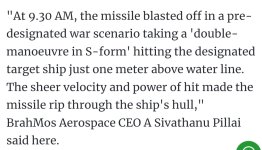
800+km range BrahMos missile successfully test fired by Indian Navy

  1. Given Parameters:
    • HQ-9 speed (v_hq9) = 1225 m/s
    • BrahMos speed (v_brahmos) = 1020 m/s
    • Maximum altitude for interception (h_max) = 30000 m
    • Initial distance between the 052D (defender) and the target = 10.9 km = 10900 m
  2. Time taken for BrahMos to reach h_max:
    • Time_brahmos = h_max / v_brahmos = 30000 m / 1020 m/s ≈ 29.41 seconds
  3. Distance covered by BrahMos in time_brahmos:
    • Distance_brahmos = Time_brahmos * v_brahmos ≈ 29.41 s * 1020 m/s ≈ 29999.6 m
  4. Remaining distance for HQ-9 to intercept BrahMos:
    • Remaining_distance = Initial_distance - Distance_brahmos
    • Remaining_distance = 10900 m - 29999.6 m ≈ -19099.6 m
  5. Analysis:
    • The negative remaining distance indicates that the BrahMos has already surpassed the interception point before the HQ-9 missile could reach it.
    • Thus, based on these calculations, the HQ-9 missile would not intercept the BrahMos missile under these conditions.
In this scenario, the BrahMos missile outpaces the HQ-9 and reaches its maximum altitude before the HQ-9 can intercept it. Therefore, interception by the HQ-9 missile is not feasible within the given parameters.
Weird calculation logic
Can you explain the following points?
According to what you said, the target found by 052d is 30km away
So why
Initial distance between the 052D (defender) and the target = 10.9 km = 10900 m
Instead of 30000m?

Remaining distance = initial distance - Distance_brahmos
Why is Distance_brahmos 29999.6 m?
This means that the target you claimed flew 30,000m in 29 seconds, the 052D did not launch a missile after the target flew for 29 seconds. Can you explain why?
 
Its also depends on sea state of the ocean, in calm oceans it could cruise 1 meter above the ocean but much reduce speed not a top speed of 2.8 Mach because of lot of drag/air resistant

Analysis of BrahMos Anti-Ship Missile Flight Paths​

BrahMos Missile Capabilities:​

  1. Double S-Maneuver Path:
    • The missile performs high-speed, complex maneuvers in an S-form.
    • Final approach is extremely low, hitting just one meter above the waterline.
    • Designed to evade horizontal detection and interception, presenting a challenging engagement profile due to its unpredictable path and low altitude.
  2. Vertical Steep Dive Path:
    • The missile executes a near-vertical dive, descending at a 90-degree angle in the terminal phase.
    • This path makes it an "ultimate aircraft carrier killer" due to the difficulty of detecting and intercepting a target descending from directly above.

Comparative Lethality and Difficulty of Interception​

Lethality:​

  • Double S-Maneuver:
    • Lethal due to its low-altitude terminal attack, minimizing reaction time for ship defenses.
    • Complex maneuvers make it difficult to predict and track.
  • Vertical Steep Dive:
    • Extremely lethal, especially against large targets like aircraft carriers.
    • High kinetic energy from the steep descent, combined with precise targeting, results in devastating impact.

Difficulty of Interception:​

  • Double S-Maneuver:
    • Harder to track due to unpredictable lateral movements.
    • Low-altitude approach reduces radar line-of-sight and reaction time.
  • Vertical Steep Dive:
    • Hard to detect due to high descent angle.
    • Requires interception systems with full vertical coverage and quick reaction capability.

SAM Systems Evaluation: HQ-16FE vs. LR-SAM​

HQ-16FE:​

  • Strengths:
    • Advanced phased array radar with a range of at least 250 km.
    • Multi-target tracking capability.
  • Weaknesses:
    • Elevation coverage limited to 0° to 80°.
    • Less suitable for near-vertical or high-angle interceptions.
  • Interception Analysis:
    • Double S-Maneuver: The HQ-16FE might struggle with the low-altitude, high-maneuverability approach due to potential gaps in radar coverage and slower reaction times.
    • Vertical Steep Dive: The system is likely to fail against a 90-degree dive due to its inability to track targets at steep vertical angles.

LR-SAM:​

  • Strengths:
    • Full 0° to 90° elevation coverage.
    • Detection range up to 450 km.
    • Rapid reaction time.
    • Dual-pulse solid propulsion and active seeker for precise terminal guidance.
  • Weaknesses:
    • None specific for the discussed threat profiles.
  • Interception Analysis:
    • Double S-Maneuver: More capable of tracking and intercepting due to better maneuverability and reaction times. However, the low-altitude approach still presents challenges.
    • Vertical Steep Dive: Well-suited to intercept steep dive attacks due to full vertical coverage and rapid response capabilities.

Conclusion:​

Most Dangerous and Lethal Path:

  • Vertical Steep Dive is considered more lethal and difficult to intercept, especially for large targets like aircraft carriers. The near-vertical descent increases impact energy and complicates detection and interception.
Most Difficult to Intercept:

  • Both flight paths are challenging, but the Vertical Steep Dive presents the greatest difficulty due to the need for full vertical coverage and rapid reaction.
System Likely to Fail:

  • HQ-16FE would likely fail against both flight paths of the BrahMos missile:
    • Double S-Maneuver: Struggles with low-altitude tracking and high maneuverability.
    • Vertical Steep Dive: Cannot track targets descending from 90 degrees.
System Likely to Succeed:

  • LR-SAM is better equipped to handle both flight paths:
    • Double S-Maneuver: Enhanced maneuverability and quick reaction times, though challenging due to low altitude.
    • Vertical Steep Dive: Full 0° to 90° coverage makes it capable of intercepting near-vertical threats effectively.
In summary, the LR-SAM system is more capable of dealing with both flight paths of the BrahMos missile, particularly the steep dive, which is the most lethal and difficult to intercept. The HQ-16FE system is less likely to succeed against these advanced attack profiles due to its limited elevation coverage and potentially slower reaction capabilities.
 
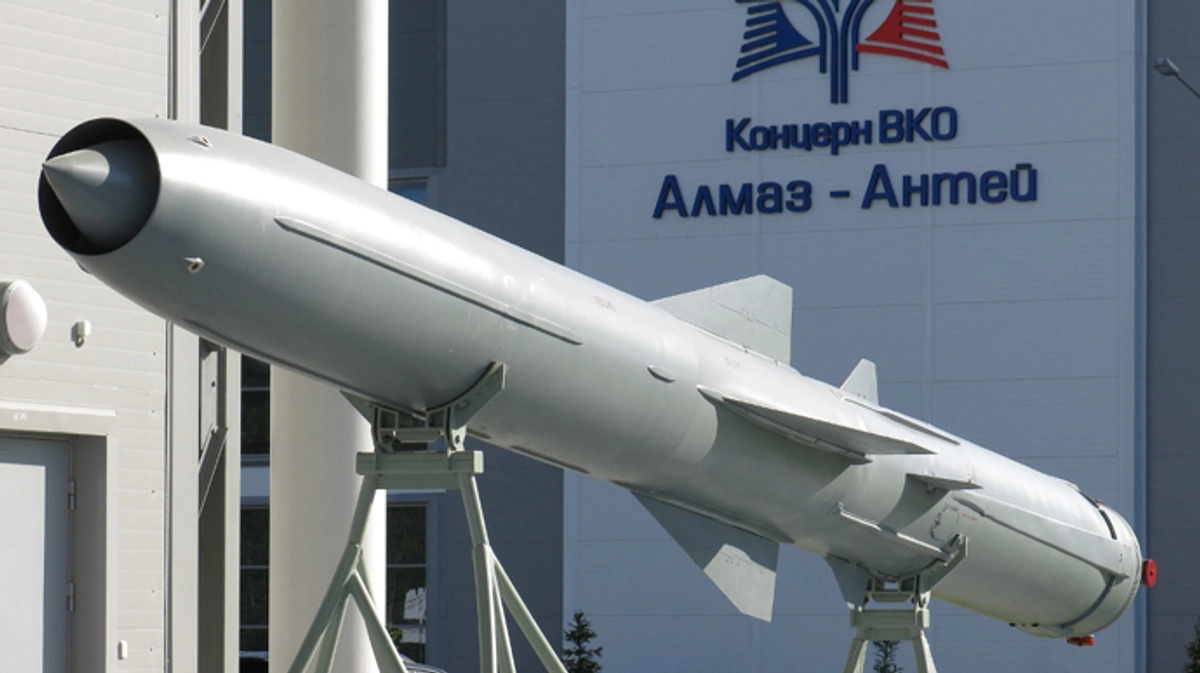
How come the Russians aren’t using Brahmos to target Ukrainian air defense systems that are wrecking havoc on Russian missiles?

In fact, rather than use the Brahmos, the Russians are upgrading their Onika, which the Brahmos is a derivative of, to target Ukraine’s air defense systems. Something’s amiss!

 
How come the Russians aren’t using Brahmos to target Ukrainian air defense systems that are wrecking havoc on Russian missiles?
Russia is using Onyx missiles in their attacks on Ukraine, targeting both military and civilian areas from positions like Crimea.
 
In fact, rather than use the Brahmos, the Russians are upgrading their Onika, which the Brahmos is a derivative of, to target Ukraine’s air defense systems. Something’s amiss!
India has upgraded its BrahMos missile with a newer RF scan millimeter-wave imaging seeker, making it more precise and better at tracking targets.
 
Russia is using Onyx missiles in their attacks on Ukraine, targeting both military and civilian areas from positions like Crimea.

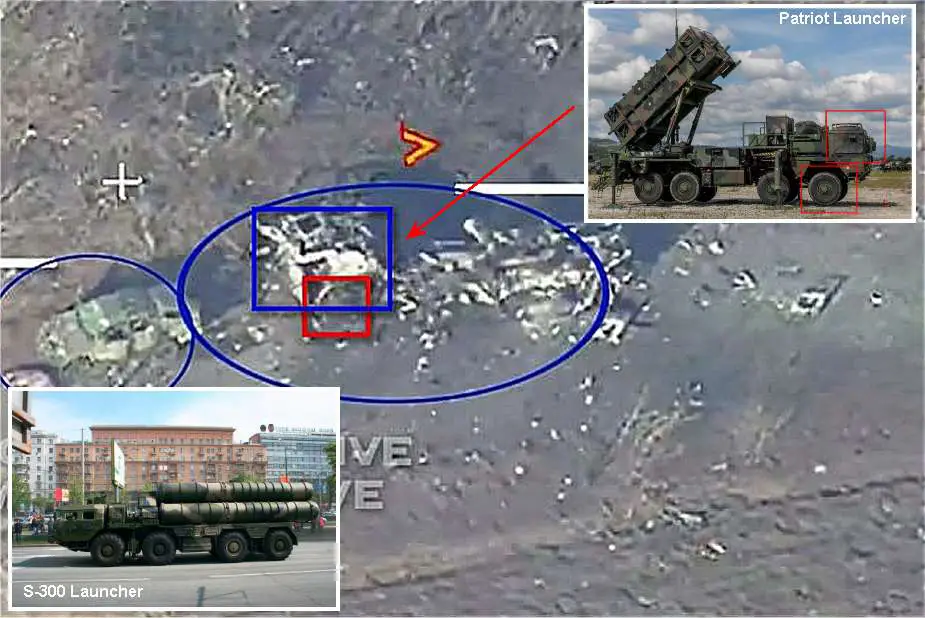
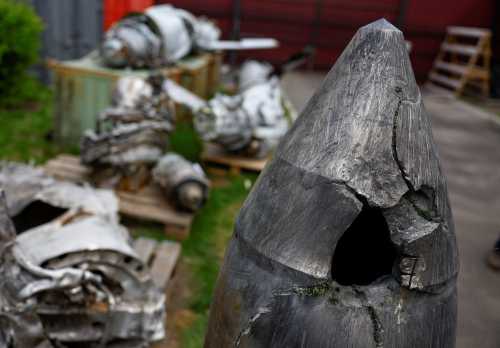
Russia hasn’t destroyed any of the patriot systems, only marginally damaged on patriot system using its hypersonic missiles. Even their hypersonic missiles are getting decimated in Ukraine by the patriot systems. Russian propaganda aside, if the Oniks were effective, they would have used against the Patriot missile system which is making mockery out of their missiles and aerial assets.
 
Even their hypersonic missiles are getting decimated in Ukraine by the patriot systems.
The Kinzhal missile achieves hypersonic speeds primarily during its terminal phase, akin to other quasi-ballistic missiles such as India's Pralay and Shaurya, which demonstrate similar flight characteristics in a depressed trajectory. While not invincible, the Kinzhal system is employed for mass saturation attacks.
 
Last edited:
Russian propaganda aside, if the Oniks were effective, they would have used against the Patriot missile system which is making mockery out of their missiles and aerial assets.
NATO's air defense systems couldn't stop missiles like Oniks or the newer air launched missile KH22. The Russians have showcased the steep dive capability of their newer, modernized KH22, akin to the BrahMos, which Ukrainian commanders have said is causing big trouble for Ukrainian air defense systems. Both Oniks and KH32 have caused a lot of damage to Ukrainian military bases and other important places.
 
NATO's air defense systems couldn't stop missiles like Oniks or the newer air launched missile KH22. The Russians have showcased the steep dive capability of their newer, modernized KH22, akin to the BrahMos, which Ukrainian commanders have said is causing big trouble for Ukrainian air defense systems. Both Oniks and KH32 have caused a lot of damage to Ukrainian military bases and other important places.

That’s an absolute lie, man. The Russians have not destroyed a single Patriot missile system. Their hypersonic missiles are falling from the sky. If the Russians had any faith in their Oniks and Brahmos, they would have used them. The fact they don’t despite the dire need, says a lot.

 
That’s an absolute lie, man.
How can you deny it when I've already shared the article link in post #83? You're deluding yourself. Accept it gracefully when even Ukrainians themselves are attesting that both supersonic cruise missiles, Oniks and KH22, have caused extensive damage within Ukraine's military installations.
 
The Russians have not destroyed a single Patriot missile system.
Post #86 contains a link to the article showcasing the wreckage of the Patriot air defense system. No system is invincible.
 

Users who are viewing this thread

Latest Posts

Back
Top