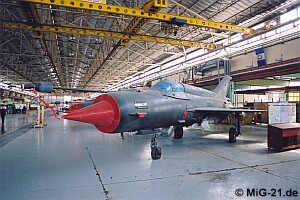
Regarding the development of the MIG-21 aircraft, there is not much information currently available because part of it is not published to the media, but you can find out the extent of the development of the MIG-21 aircraft.
LINK
https://www.mig-21.de/english/technicaldataupgrades.htm
| Notice: This page is not subject to any update. For updated information please refer to the German pages of this websiteor the publications by the author.
About 1000 MiG-21 are still in service all around the world. Most of MiG-21 user countries cannot afford new fighteraircraft. It is no wonder that at least three major upgrade programmes are running.
The MiG-21-93 of RAC MiG / SOKOL (Russia), the MiG-21 LanceRof Aerostar / Elbit (Romania / Israel)and the MiG-21 2000 of Israel Aircraft Industries (IAI) were on display atmany recent airshows and aviation fairs. And every upgrade programme has found at least one customer:
| Elbit / Aerostar MiG-21 LanceR |
|---|
|
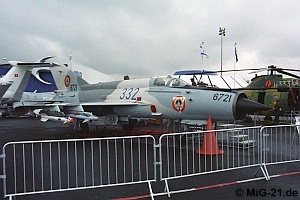
| The most successful upgrade programme for the MiG-21 was presented at all major airshows - seen here at Paris Le Bourget 1997. |
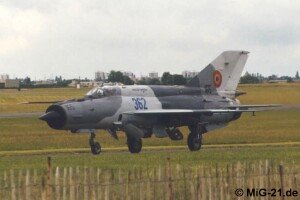
| Despite its Romanian roundels this aircraft never served with the Romanian Air Force:
MiG-21bis based prototype of LanceR III programme at
Aerosalon Le Bourget 1999. |
| RAC MiG / SOKOL MiG-21-93 |
|---|
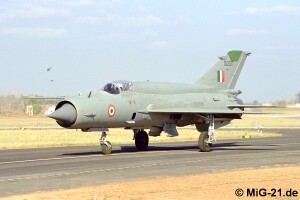
| | The Indian MiG-21bis UPG is very close to MiG-21-93 standard. |
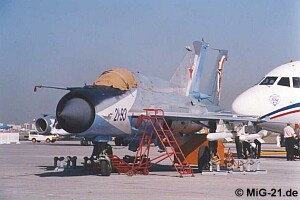
| | Looking for customers in Arabia:
MiG-21-93 at Dubai Airshow 1999. |
| Israel Aircraft Industries (IAI) MiG-21 2000 |
|---|
| | Israel Aircraft Industries (IAI) uses its experience with war prizes of Soviet origin for the upgrade business. A comprehensive upgrade package for the MiG-21 is offered while it seems that the new single piece windshield was fitted only to the company demonstrator IAI-304 which is shown here.
|
|
MiG-21 equals the US F-16 in avionics complexity, a pilot says
By Alexey Lenkov On
Mar 4, 2024
Share
The first batch of seven pilots in Romania’s Air Force have completed their training at the International Training Center at the 86th Air Force Base. This is major news as it signifies their transition to flying F-16 fighter jets with confidence. Notably, before this, these pilots were handling the MiG-21 LanceR, a jet that the Romanian Air Force retired in May 2023.
Photo credit: RNAF
Eager to understand their experiences with shifting to the F-16, we asked these pilots to share their thoughts. The responses we received, as per Romanian sources, are captivatingly insightful.
Let’s look deeper. A Romanian television channel aired an interview with a pilot, code-named
“Red”, who had recently transitioned to the F-16. When asked about the discernable differences between the two aircraft, Red stated that in terms of avionics, the contrast was minimal. The main differences were predominantly in the aircraft’s aerodynamic traits.
“The transition to the F-16 was rather smooth in regards to avionics. The F-16 is essentially a more versatile and efficient aircraft, boasting several onboard systems. However, what really stood out to us were the aircraft’s power dynamics and flight mechanics,” elaborated the Romanian
“Red” pilot.
Upgrades
It might seem counterintuitive to suggest that the distinction in avionics between the F-16 and MiG-21 isn’t vastly different. But let’s clarify, we’re referring here to the Romanian MiG-21 Lancer, upgraded in collaboration with Israeli Elbit Systems, which significantly improved the suite of onboard equipment.
Moreover, these aircraft have modern EL/M-2032 radars installed instead of the outdated onboard versions. These radars enable a detection range of 75 to 150 kilometers [according to several sources] and have the capability to distinguish targets against ground clutter. So yes, from the perspective of Romanian pilots, the disparity in the onboard electronics of the F-16 and MiG-21 LanceR might appear marginal.
Photo credit: Romanian AF
Do keep in mind though, that the upgrades to the Romanian MiG-21’s onboard equipment, despite its current state-of-the-art status, didn’t allow these aircraft to successfully intercept the ‘Calibers’ over Romanian airspace in February 2023. Ultimately, despite the inclusion of Israeli electronics, the physical wear and tear issues of the aging Romanian MiG-21s couldn’t be overcome, resulting in their retirement last May.
Romanian MiG-21s
Jetting into history in 1962, Romania’s Air Force welcomed its very first MiG-21F-13 aircraft. This marked the beginning of a new era. Others followed over time, namely, the MiG-21PF [colloquially known as the MiG-21RFM), the MiG-21PFM (or MiG-21RFMM], and, of course, the MiG-21M and MiG-21MF. In an impressive display of aviation power, over 400 MiG-21s joined the air squadron. The last recruit took to the air in 1982, according to the ROAF’s records.
Photo credit: USAF
It wasn’t until 1992 that the Romanian Air Force initiated a progressive plan to upgrade the MiG-21 aircraft. The goal was to ensure seamless opportunities for NATO integration and enhance their mission capability. They wanted to be fully prepared to meet the high demands of contemporary air combat.
More recently, Romania expanded its air fleet with the purchase of 32 F-16 Fighting Falcons from Norway, for 388 million euros. This purchase is part of their strategic move towards integrating the F-35 into their fleet. As it stands, Romania proudly fields a full squadron of 17 F-16 aircraft, all procured from Portugal. Of the additional 32 F-16s from Norway, three have already been introduced and are adjusting to their new Romanian skies.
About MiG-21
Photo credit: Wikipedia
Originating from the Soviet Union’s Mikoyan-Gurevich Design Bureau, the MiG-21 is a legendary supersonic jet fighter and interceptor aircraft. This exceptional offering holds the record as one of the most widely manufactured jet aircraft ever, with over 11,000 units assembled since its debut in 1959. Over 50 air forces worldwide have recognized the MiG-21’s key attributes—its simplicity, robustness, and high performance.
The MiG-21, despite its age, stands out for its remarkable specifications. The aircraft measures 15.76 meters in length, with a wingspan of 7.15 meters and a height of 4.125 meters. At takeoff, it weighs an impressive 9,400 kg. It has fantastic speed, reaching up to Mach 2.05 at high altitudes. Additionally, with drop tanks, its range extends to an impressive 1,210 km. However, that’s not all—the MiG-21 can reach an apex of 19,000 meters.
Under its metal exterior, a single Tumansky R25-300 after-burning turbojet engine powers the MiG-21. This engine provides a peak thrust of 40.21 kN [9,040 lbf] when dry and 69.62 kN [15,650 lbf] with afterburner engagement, setting the stage for the aircraft’s exceptional speed and climb rate. As a result, it ascends to its maximum altitude within mere minutes.
The MiG-21 houses a single 23mm GSh-23L autocannon with the capacity to hold 200 rounds when it comes to armaments. It is equipped with four underwing hardpoints that can accommodate up to 2,000 kg of payload, a feature that allows it to carry a broad spectrum of weapons—from air-to-air and air-to-ground missiles to bombs and rocket pods. Certain versions of the MiG-21 are even capable of carrying nuclear bombs.
***
Follow us everywhere and at any time. BulgarianMilitary.com has responsive design and you can open the page from any computer, mobile devices or web browsers. For more up-to-date news, follow our Google News, YouTube, Reddit, LinkedIn, Twitter and Facebook pages. Our standards: Manifesto &
https://bulgarianmilitary.com/2024/...-us-f-16-in-avionics-complexity-a-pilot-says/