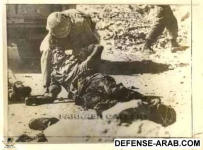
Here are some facts about this war which are almost pushed aside from the military -- and in some considerations -- the political aspect but are equally, if not more important than the immediate aftermath of the war and it immediate results.
The notion that was officially portrayed in Israel as a "military victory" and referenced as the "Yom Kippur War" since that was part of the Egyptian plan, to carry out the war on the Jewish holiday to maximize the element of surprise. Whereas it's known to us in Egypt and the Arab world simply as the "October war of 1973" or the "Ramadan War" as it took place in the month of Ramadan in 1973 and was dubbed "Operation Badr," referring to the Prophet's glorious battle of Badr in 624 CE against the Quraysh of Makkah.
Despite the war results were unequivocally clear as the Israelis were forced to withdraw considerably into the heart of Sinai to create the buffer zone while Egyptian military gains were kept by Egypt couldn't be clearer as to who the victor was. To add to that immense success, the aftermath of the war not only resulted in their loss of the Bar Lev line and a 30km stretch of Sina along the Suez Canal, but it triggered the next series of events that caused the Israelis to gradually withdraw from the occupied territories the previously gained in 1967 and that had been under their control since. Eventually, this led to peace treaty and in 1979, the Sinai Peninsula was completely returned to Egypt.
That war had a long-lasting and profound negative impact on the Israelis that lasts until today even. It was a brutal war from their perspective while it's celebrated every year and more in Egypt. It was a rather difficult war which was followed by profound changes in Israel's domestic politics. Golda Meir, the cruel wench and really an authoritarian figure (the only woman to rule Israel), no longer resembled the image she originally portrayed, which was derived from the Jewish heritage of Edisha Mama (Jewish mother) formed among many citizens of the former Soviet Union (something I eluded to in one of my previous posts about the Soviet loyalty to its Jewish population and diaspora) while her image in Israel was associated with discriminated by her suppression of Mizrahi Jews, and the blame for corruption within the Israeli government, as well as her being the reason for the deaths of many Israelis in the decision to conduct the immediate counterattack to the initial crossing of the canal by and the ensuing annihilation of 1/3 of the Israeli air force and hundreds of tanks which were crushed by the Egyptian army tanks, infantry with RPG and especially the 9M14 Malyutka (Sagger) missiles.
On April 11, 1974, Golda Meir and her cabinet (following the Agranat Commission's findings) was forced to resign almost in shame, and Israel's "Iron Lady" left the Israeli political scene shortly thereafter. Three years later, the leader of the modern Likud party, Menachem Begin, became Israel's prime minister, and his 1977 peace agreement with Sadat ended nearly 30 years of the Jewish state's left-wing Labor Party's dominance of Israeli politics.
Another -- and rather important -- outcome of the Yom Kippur War is that many Israelis have recognized the limits of their military power. The Israeli occupation army was neither "superior" nor was it the "invincible army," nor were neighboring countries powerless, least of all Egypt. The course of the war also showed the extent to which the Israeli criminal war machine depended on foreign aid, and how the airlift which carried thousands of tons of U.S. ammunition and military equipment, saved the Israelis from certain and complete loss.
After the October War of 1973, controversy took place within the Israeli military and academic circles with voices calling for diplomatic compromises with neighboring Arab states and with the Palestinian population living on land seized lands stolen & occupied in 1967.
Much of that willingness to befriend and appease its Arab neighbors is evident with their constant push for normalization with countries like Saudi Arabia, the UAE and others. In the meantime, while Egypt has enjoyed a war-free 50+ years since, Israel has been mired in wars and conflict one after the other since then not to mention the constant fighting between it and the Palestinian resistance for freedom and people.
For many ordinary Israelis who survived the battle's horrific experiences in Sinai and the Golan, the events of 1973 have remained traumatic and psychologically embedded in their minds. These are some of the many impactful results from this war that tend to go unnoticed for the most part, giving Egypt the ultimate edge in the end.