Chinese Economy: General News, Updates and Discussions

Russians' Approval of China's Leadership Firms as Global Order Shifts

Gap between positive ratings of Beijing and Washington highest for any country
October 27, 2025

408f658b-aa2d-4e14-a592-e7cf780a57b1.jpg

by Benedict Vigers

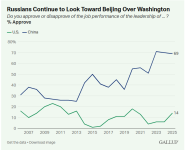
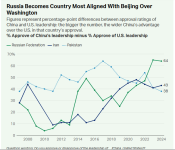
LONDON — Russians’ approval of China’s leadership has surged as Moscow has grown closer to Beijing since the full-scale invasion of Ukraine in 2022. In 2025, 69% of Russians approve of China’s leadership, nearly double the 36% recorded in 2019. It has remained high and steady since 2023.

By contrast, 14% of Russians approve of U.S. leadership, similar to the average level seen during Donald Trump’s first term (12%) and slightly higher than the single-digit approval seen during the last three years of Joe Biden’s presidency. The current 55-percentage-point approval gap between China and the U.S. marks a shift from the power dynamics over a decade ago, when the approval gap averaged eight points between 2009 and 2013.

微信图片_20251027161504.png
The surge in approval ratings of Beijing between 2022 and 2023 (20 points) was on par with the increase measured between 2013 and 2014 (17 points) following Crimea’s integration with Russia.

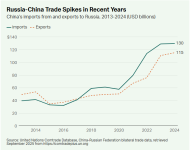
Increased approval of Beijing since 2022 coincides with surging bilateral trade. While trade was already growing before then, it spiked after the invasion of Ukraine and has remained elevated, with Chinese imports from and exports to Russia both surpassing $100 billion. As Western sanctions restricted Moscow’s access to international markets, China became a lifeline for sustaining Russia’s economy. Although trade volumes dipped slightly in early 2025, China remains Russia’s most important economic partner.

微信图片_20251027161633.png
In addition to their heightened economic ties, Moscow has been drawing closer to Beijing in political terms. In September, President Vladimir Putin joined President Xi Jinping and North Korea’s Kim Jong Un at a major Victory Day military parade in China. Putin has referred to Xi as his “dear friend,” with the pair meeting on more than 40 occasions, and has noted that relations between the two powers “are at an unprecedented level.”

Outside of Africa, Russia Most Positive Toward China​

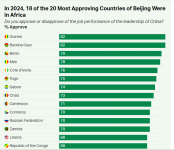
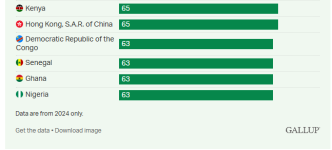
Russia is somewhat of an outlier in China’s global soft power footprint. Of the 20 countries or territories where China was viewed most positively in 2024, Russia was one of only two outside of Africa, the other being Hong Kong, S.A.R. of China. Russians’ approval of Beijing stood at 70% in 2024, on par with 69% in 2025.

微信图片_20251027161816.png微信图片_20251027161842.png
Last year, at least three in four adults in Guinea, Burkina Faso, Benin, Mali, Cote d’Ivoire and Togo expressed approval of Beijing, with Russia tying for the 10th most approving country in the world.

Russia Overtakes Iran, Pakistan in Leaning Eastward​

Even though a handful of countries in Africa have higher approval of China than Russia does, no other country in the world has a more positive view of China relative to the United States.

Since 2023, the gap between approval of China and the U.S. has been larger in Russia than any other country globally. In 2025, the difference stands at 55 points, slightly down from more than 60 points in the two previous years. While global data collection is not yet completed for all countries in 2025, Russia is unlikely to lose its top spot in leaning toward Beijing over Washington.

微信图片_20251027162042.png
This was not always the case. In earlier years, countries like Iran and Pakistan leaned more toward Beijing over Washington than Russia did. But Moscow has since overtaken them, reflecting the depth of its Eastward pivot in both policy and public opinion.

Majority Disapproval of the United Nations​

Gallup asked a new question in 2025 about people’s approval of the United Nations. Almost three in four Russians (73%) disapprove of the job performance of the United Nations, compared with 15% who approve, on par with the proportion who approve of Washington (14%).

Russia’s relationship with the U.N. has deteriorated since the invasion of Ukraine, as the General Assembly and human rights organizations have condemned Moscow, while Russia has used its Security Council veto to block several resolutions. Much of the U.N.’s role has shifted to humanitarian efforts, including aid delivery, rights monitoring and the Black Sea Grain Initiative.

Bottom Line​

Russians had been warming toward Beijing even before its invasion of Ukraine, but approval has strengthened since. Today, Russia not only gives China its highest ratings outside of Africa but also leads the world in relative alignment with Beijing over Washington. These views reflect the two countries’ deepening political and economic ties and highlight how Russian opinion has moved increasingly Eastward in a changing global order.
 

Explanation of the 'Proposal of the Central Committee of the Communist Party of China on Formulating the Fifteenth Five-Year Plan for National Economic and Social Development'​

Xinhua News Agency· 16:34

Main Considerations in Drafting the Proposal and the Basic Content of the Proposal

The overall consideration in drafting the Proposal is to follow the two-step strategy for building a great modern socialist country in all respects as outlined at the 20th National Congress of the CPC, accurately grasp the significant role of the '15th Five-Year Plan' period in the process of basically achieving socialist modernization, conduct an in-depth analysis of domestic and international situations, and systematically plan and strategically deploy China’s economic and social development during the '15th Five-Year Plan' period.

In the process of drafting the Proposal, we focused on the following key points: First, adhering to goal-oriented and problem-oriented approaches, based on the fundamental positioning of consolidating foundations and exerting comprehensive efforts, with the aim of laying a more solid foundation for achieving the goal of socialist modernization through systematic planning, and addressing the challenges posed by the new situation of global changes unseen in a century and prominent issues in development by strengthening weak areas and addressing shortcomings. Second, adhering to systemic thinking, comprehensively deploying economic and social development and party building work in accordance with the requirements for advancing the 'five-in-one' overall layout and coordinating the 'four-pronged comprehensive strategy.' Third, adhering to further comprehensive deepening of reforms, focusing on using reform methods to resolve development challenges, adding momentum and stimulating vitality for development. Fourth, adhering to expanding opening-up, placing development on the basis of self-reliance while making full use of global factors and market resources.

The Proposal consists of 15 parts, divided into three major sections. The first section includes the first and second parts, serving as the general discussion, mainly elaborating on the significant achievements made during the '14th Five-Year Plan' period, the pivotal role of the '15th Five-Year Plan' period in the process of basically achieving socialist modernization, the profound and complex changes in the development environment during the '15th Five-Year Plan' period, as well as the guiding ideology, principles followed, and main objectives for economic and social development during this period. The second section includes parts three to fourteen, providing detailed discussions, focusing on key issues affecting the overall situation and long-term prospects, and outlining strategic tasks and major initiatives in various fields for the '15th Five-Year Plan' period, specifying ideas and priorities from industrial development, scientific and technological innovation, domestic markets, economic systems, opening-up, rural revitalization, regional development, to cultural construction, livelihood security, green development, security development, and national defense construction. The third section includes part fifteen and the concluding remarks, primarily addressing tasks such as upholding and strengthening centralized and unified leadership of the CPC Central Committee, advancing socialist democratic legal system construction, Hong Kong, Macao, and Taiwan affairs, promoting the formation of a common destiny for humanity, and fully mobilizing the enthusiasm, initiative, and creativity of the entire society.

Several Key Issues Requiring Explanation

The Proposal puts forward some important viewpoints and major measures. Here, brief explanations are provided for several key issues.

First, regarding the significant position of the '15th Five-Year Plan' period. Achieving socialist modernization is a historical process of step-by-step progress and continuous development, requiring relentless efforts and successive struggles. The Proposal states that the '15th Five-Year Plan' period holds a pivotal position in the process of basically achieving socialist modernization, a judgment based on the historical tasks that this period should undertake. The 20th National Congress of the CPC set the target of basically achieving socialist modernization by 2035. The '14th Five-Year Plan' period was the first five years, during which a solid foundation was laid and a good start achieved. The '15th Five-Year Plan' period is a critical time for consolidating the foundation and exerting comprehensive efforts; formulating and implementing a sound '15th Five-Year Plan' will lay a more solid foundation for basically achieving socialist modernization by 2035.

Based on this fundamental positioning, the Proposal outlines the development for the '15th Five-Year Plan' period, maintaining continuity with the concepts and approaches proposed in the '14th Five-Year Plan,' while accurately grasping the trends of China’s development over the next five years, putting forward an overall approach, major principles, main objectives, and strategic tasks that are realistic and forward-looking. This time window must be seized to consolidate and expand advantages, remove bottlenecks, and strengthen weak areas, thereby gaining strategic initiative in fierce international competition, making significant breakthroughs in strategic tasks crucial to Chinese-style modernization, and ensuring decisive progress in basically achieving socialist modernization.

Second, regarding the economic and social development goals for the '15th Five-Year Plan' period. Scientifically setting development goals is crucial for formulating and implementing a five-year plan. The Proposal, taking into account the basic positioning and stage-specific requirements of the '15th Five-Year Plan' period, clarifies the main economic and social development goals. By 2035, when socialist modernization is basically achieved, one important indicator will be that per capita GDP reaches the level of moderately developed countries, which requires maintaining an appropriate growth rate during the '15th Five-Year Plan' period. Based on thorough research and scientific arguments, the Proposal sets forth key goals such as maintaining economic growth within a reasonable range, steadily improving total factor productivity, fully releasing economic growth potential, synchronizing residents’ income growth with economic growth, synchronizing labor remuneration increases with labor productivity increases, and continuously expanding the middle-income group. Meanwhile, considering current issues such as increased downward pressure on the domestic economy and insufficient effective demand, the Proposal proposes targets such as significantly increasing the household consumption rate and continuously enhancing the role of domestic demand as the primary driver of economic growth.

In reference to past practices, the draft of the "Recommendations" proposes that the socio-economic development goals for the '15th Five-Year Plan' period primarily consist of qualitative requirements, while necessary quantitative requirements and some specific work arrangements will be left for further study and determination during the formulation of the Outline of the Plan, in order to better reflect and leverage the macro-guidance role of the "Recommendations."

Third, regarding the theme of promoting high-quality development. The "Recommendations" are consistent with the 14th Five-Year Plan, continuing to set the promotion of high-quality development as the theme of socio-economic development for the '15th Five-Year Plan' period, requiring adherence to economic construction as the central task, fully, accurately, and comprehensively implementing the new development philosophy, achieving effective improvement in quality and reasonable growth in quantity, and promoting sustained and healthy economic development along with comprehensive social progress. To promote high-quality development, the most crucial step is to accelerate high-level technological self-reliance and strength, actively develop new forms of productivity, and achieve substantial and breakthrough progress in promoting scientific and technological innovation, accelerating the cultivation of new drivers, and optimizing and upgrading the economic structure.

The draft of the "Recommendations" highlights the leading role of scientific and technological innovation, making arrangements in building a modern industrial system, accelerating high-level technological self-reliance and strength, and expediting the comprehensive green transformation of economic and social development. It proposes optimizing and upgrading traditional industries, fostering the growth of emerging and future industries, and consolidating the foundation of the real economy; it suggests strengthening original innovation and tackling key core technologies, promoting the deep integration of scientific and technological innovation with industrial innovation, advancing education, science, and talent development in an integrated manner, and furthering the construction of Digital China; it also calls for accelerating the establishment of a new energy system and fostering green production and living patterns. It should be noted that developing new forms of productivity requires certain endowment conditions and must take into account practical feasibility. The draft emphasizes developing new forms of productivity according to local conditions, aiming to guide everyone to work scientifically, rationally, and factually, preventing blind mass action.

Fourth, regarding strengthening the domestic cycle and ensuring smooth domestic and international dual circulation. The more severe and complex the external environment becomes, the more imperative it is to accelerate the formation of a new development pattern and firmly grasp the initiative of development. At present and for the foreseeable future, we must focus on strengthening the domestic cycle, accelerating the formation of a robust domestic economic circulation system, and offsetting the uncertainty of the international cycle with the stability of the domestic cycle.

The draft of the "Recommendations" emphasizes strengthening the domestic cycle, making arrangements for building a powerful domestic market and accelerating the formation of a high-level socialist market economic system. It stresses adhering to the strategic cornerstone of expanding domestic demand, combining the improvement of people's livelihood with consumption promotion and investment in both physical and human capital, vigorously boosting consumption, expanding effective investment, and decisively removing obstacles hindering the construction of a unified national market. It also emphasizes fully stimulating the vitality of various business entities, expediting the improvement of the mechanism for market-oriented allocation of factors, and enhancing the effectiveness of macroeconomic governance. Meanwhile, it proposes expanding international circulation, steadily increasing institutional openness, upholding the multilateral trading system, and jointly building a high-quality Belt and Road Initiative.

Fifth, regarding solid progress toward common prosperity for all. Chinese-style modernization is modernization aimed at common prosperity for all. Since the 18th CPC National Congress, we have adhered to our original aspiration, considered issues from the standpoint of the people, promoted coordinated regional development, taken strong measures to ensure and improve people’s livelihoods, won the battle against poverty, and completed the building of a moderately prosperous society in all respects, thereby creating favorable conditions for promoting common prosperity. The draft of the "Recommendations" prominently emphasizes in its guiding ideology that solid steps will be taken toward common prosperity for all, which serves as an overarching requirement for socio-economic development during the '15th Five-Year Plan' period.

The draft of the "Recommendations" firmly adheres to the goal requirements of common prosperity, deploying a series of balanced and accessible policy measures around ensuring and improving people's livelihoods, such as promoting high-quality and full employment, perfecting the income distribution system, providing education that satisfies the people, strengthening the social security system, promoting high-quality development of the real estate sector, accelerating the construction of a Healthy China, promoting high-quality population development, and steadily advancing equalization of basic public services. Aiming to narrow regional disparities and urban-rural differences, it deploys pragmatic measures to expedite agricultural and rural modernization, solidly advance comprehensive rural revitalization, optimize regional economic layout, and promote coordinated regional development. With a view to enriching people’s spiritual lives, it proposes promoting and practicing the core socialist values, vigorously flourishing cultural undertakings, accelerating the development of the cultural industry, and enhancing the influence of Chinese civilization.

Sixth, regarding balancing development and security. Security is the precondition for development, and development is the guarantee of security. In the next five years, various uncertain and unpredictable risk factors in our country will significantly increase, making the task of balancing development and security even more arduous. The draft of the "Recommendations" focuses on advancing the modernization of the national security system and capabilities, proposing to improve the national security system, strengthen national security capabilities in key areas, enhance public safety governance, and perfect the social governance system. Regarding the high-quality advancement of national defense and military modernization, it suggests accelerating the construction of advanced combat capabilities, promoting the modernization of military governance, and consolidating and enhancing the integrated national strategic system and capabilities.

Seventh, regarding upholding the Party’s overall leadership. Upholding and strengthening the Party’s overall leadership is the fundamental guarantee for advancing Chinese-style modernization. The draft of the "Recommendations" aims to enhance the Party’s ability and level to lead economic and social development, emphasizing upholding and strengthening the centralized and unified leadership of the Party Central Committee, improving mechanisms for implementing major decisions of the Party Central Committee; continuously using the Party’s innovative theory to unify thoughts, will, and actions; adhering to correct personnel orientation and improving the cadre assessment and evaluation mechanism; coordinating the construction of grassroots Party organizations in all fields; persistently implementing the spirit of the Central Eight Provisions; improving the supervision system of the Party and the state; and resolutely fighting a tough, protracted, and comprehensive battle against corruption.


The CPC Central Committee's Proposal for Formulating the Fifteenth Five-Year Plan for National Economic and Social Development​


Last edited:

Survey reveals more than half of Americans want more friendly engagement with China​

Wed 29 October 2025 at 5:30 pm GMT+8

More than half of Americans say the United States should cooperate and engage with China, according to a survey released on Tuesday, a sharp increase from the 40 per cent recorded in 2024.

The results released by the Chicago Council on Global Affairs also found that a majority of Americans are against higher tariffs on Chinese imports.

"Americans' views of China are beginning to improve after several years of sharp declines," said Craig Kafura, the council's director of public opinion and US foreign policy and author of the study. "The big swings on how the US should approach China, in a very broad sense, were really interesting and really surprising."

Do you have questions about the biggest topics and trends from around the world? Get the answers with SCMP Knowledge, our new platform of curated content with explainers, FAQs, analyses and infographics brought to you by our award-winning team.

This is the first time since 2019 that a majority of Americans surveyed said they preferred a policy of "friendly" cooperation and engagement with China.

Many of the findings varied significantly by political party, reflecting the deeply partisan nature of US politics.

Kafura said the big shift in views was driven principally by more favourable views among Democrats and Independents as they alter their focus more towards internal US issues, including government corruption and threats to US democracy, rather than China's rise.

The results, drawn from three surveys taken between late July and mid-October in partnership with Ipsos, found that respondents viewed the US-China relationship as the world's most consequential. The two giant nations combined account for over 40 per cent of global GDP and over half of the world's military spending.

While 54 per cent of Democrats and 58 per cent of independents opposed higher tariffs, 63 per cent of Republicans favoured their increase, presumably reflecting support for US President Donald Trump's aggressive trade agenda.

Likewise, two-thirds of Democrats wanted the US to pursue friendly cooperation and engagement with China instead of working actively to limit its influence - a 19 per cent increase over 2024 levels. But the view among Republicans was a mirror image, with just a third in favour of more engagement.

The results come as Trump and Chinese President Xi Jinping are set to meet on the sidelines of the Asia-Pacific Economic Cooperation summit in South Korea on Thursday.

The two nations have seen trade relations involving technology, ports, rare earth minerals and tariffs, among others, crater, partially recover and plummet again since Trump returned to office in January.

Ryan Hass, a senior fellow at the Brookings Institution, said the results suggest that the China issue, which traditionally enjoyed a bipartisan consensus, now appears to be subject to growing social and political divisions.

"It feels like the discourse around China in the US is entering a more fluid stage," Hass wrote on X. "Space is opening for a broad conversation around US goals vis-a-vis China in 2028 and beyond."

e9e37b04b6fd53a71a6c453912e9dfc0

A graphic by the Chicago Council on Global Affairs shows that a majority of Americans are against higher tariffs on Chinese imports. Credit: Chicago Council on Global Affairs/Ipsos alt=A graphic by the Chicago Council on Global Affairs shows that a majority of Americans are against higher tariffs on Chinese imports. Credit: Chicago Council on Global Affairs/Ipsos>

The survey also found that Republicans are more confident about US power than Democrats, even as American views on the comparative influence of Washington and Beijing remain fairly stable since 2018.

"Although the public is confident in American military superiority over China, Americans are less confident that the United States is still the stronger economic power," the survey found.

Hass said the findings challenge the belief held by some that China, as an external enemy, could be used to help Americans overcome domestic divisions.

"There doesn't appear to be an appetite or a stomach for inflating China as a unifying threat among the American public," he said.

The results may suggest some room for improved relations, although most Americans rank China's favourability at 35 out of 100, above Russia or Iran, but roughly level with Saudi Arabia.

"I don't know if I'd characterise their views on China as warm and fuzzy," added Kafura.

"It's still not a very popular country. But there are some encouraging signs if you're sitting in China and you've been arguing for a more diplomacy-heavy approach towards the United States.

"If you're seeing in the polling, OK, well, not all Americans are unremittingly hostile to China, so maybe there's an opening here."
 

Indian woman’s post on not finding a single pothole or broken road in China goes viral​

By Sakshi Sah
Nov 08, 2025 03:03 pm IST

The post sparked a lively discussion, with many comparing China’s smooth roads to the pothole-filled roads in India.

China_1762584372178_1762584372456.png

Somya shared a photo of a clean, well-maintained street in China.(@Somya_Crazy/X)

A woman’s travel post about not seeing a single pothole or broken road in China has gone viral, prompting online comparisons with India’s road conditions.

An X user, Somya, shared a photo of a clean, well-maintained street in China with the caption, “10 days in China and haven’t seen a single pothole or broken road.”

What started as a simple remark quickly went viral, gaining over a million views and thousands of comments.

Adding to her viral post, Somya noted the irony that while the roads were flawless, using them came at a cost, 204 yuan ( ₹2,600) in tolls for a 130 km ride, nearly matching the cab fare of 237 yuan ( ₹2,900).

HT.com has reached out to the user for more details. This report will be updated when she responds.

The post was shared on November 7, 2025, and since then, it has gained 1 million views and more than 2,500 comments.

Here's how people reacted to the post:​

Social media users started praising China’s infrastructure, calling it an example of effective planning and regular maintenance. However, the discussion quickly turned toward comparisons with India.

One of the users commented, “They are decades ahead of us. Of course, you can’t question the government there.”

A second user commented, “China has incredible infrastructure, especially in tier 1 cities. You’ll get a better sense of the country if you visit some other tiers too.”

One user even attached a photo of a pothole-ridden Indian road, commenting, “In case you’re feeling homesick, here are some from back home.”

X users reacted with a mix of praise, envy, and humour. While some admired China’s spotless roads, others compared them with India’s patchy streets.
 
Meanwhile in India:
To view this content we will need your consent to set third party cookies.
For more detailed information, see our cookies page.
 
Meanwhile in India:
To view this content we will need your consent to set third party cookies.
For more detailed information, see our cookies page.

FYI, Paul Joseph Watson is literally a fascist white-supremacist.

Don't take anything he says seriously.
 
good for china and a lesson for the rest of the world.........

if u import 3rd world people and their baggage,,,,,,u will soon become that...
 

PBOC Pushes Yuan Borrowing Abroad to Internationalize Currency​

November 11, 2025 at 1:21 PM GMT+8

China’s central bank vowed to further encourage financing in the yuan by overseas entities, betting cheap borrowing costs and increased demand for the currency offshore will be crucial drivers for its globalization.

The country will promote the role of the yuan as a funding currency as one of the key steps to advance its internationalization, the People’s Bank of China said in its annual report released Oct. 30. The central bank pledged to support the use of a variety of funding products, including yuan loans, panda bonds, offshore yuan bonds and trade financing, to help make it easier for overseas institutions and corporations to obtain the currency.


Indonesia considers issuing ‘panda bonds’ as China promotes renminbi debt​


Kazakhstan Plans to Sell Bonds in Yuan to Expand China Ties​


Ethiopia is in talks with China to convert some of Addis Ababa's $5.38-billion debt to Beijing into lower-interest-rate, yuan-denominated loans. The move comes amid China's broader effort to expand the use of its currency worldwide.
 

Takaichi ignited a diplomatic dispute with Beijing after she made a statement in the Japanese parliament last week that a Chinese invasion of Taiwan could create a “survival-threatening situation” and prompt a military reaction from Tokyo.​


Tensions between China and Taiwan have been steadily escalating in recent years, reflecting longstanding political, military, and strategic complexities in the region. Taiwan’s Ministry of National Defense detected 21 sorties of Chinese military aircraft and three naval vessels operating around its territorial waters as of 6 am (local time) on Friday. According to the MND, of the 21 aircraft, 18 crossed the median line and entered Taiwan’s northern and southwestern ADIZ. Meanwhile, on Friday, China’s Ministry of Defense stated that if Japan attempts military intervention in Taiwan, it would certainly face a ‘crushing’ military defeat by the Chinese military.

https://vdo.ai/contact?utm_medium=video&utm_term=india.com&utm_source=vdoai_logo


The statement comes amidst increasing rhetoric around comments made by Japanese Prime Minister Sanae Takaichi about Taiwan. On Friday, Tokyo summoned Beijing’s ambassador to Japan regarding an online post about PM Takaichi made by a senior Chinese diplomat. The situation continues to deepen the tit-for-tat dispute that has arisen over the past week.


Takaichi ignited a diplomatic dispute with Beijing after she made a statement in the Japanese parliament last week that a Chinese invasion of Taiwan could create a “survival-threatening situation” and prompt a military reaction from Tokyo.


The issue became more contentious on Saturday, when Xue Jian, China’s consul general in Osaka, shared a news article on X regarding Takaichi’s comments on Taiwan along with a note stating, “the dirty neck that sticks itself in must be cut off.” The post was later deleted, but not before drawing harsh condemnation from Japanese lawmakers and further raising tensions in diplomatic relations.


Add India.com as a Preferred Source


The Ministry of Foreign Affairs of Japan called in the Ambassador of China to Japan to protest what they called “highly inappropriate” statements offered by the Chinese diplomat Xue. While some senior Japanese politicians have called for Xue to be expelled, however, Tokyo has only asked Beijing to take “appropriate measures” without elaboration. The spokesperson of the Ministry of Defense of China, Jiang Bin, called Takaichi’s comments extremely irresponsible and dangerous.

In a statement, Jiang stated, “Should the Japanese side fail to draw lessons from history and dare to take a risk, or even use force to interfere in the Taiwan question, it will only suffer a crushing defeat against the steel-willed People’s Liberation Army and pay a heavy price,” as reported by Reuters.

In the meantime, Japan’s ambassador in China has been summoned by China’s Foreign Ministry to express a “strong protest” over Takaichi’s comments. This marks the first time in more than two years that Beijing has summoned a Japanese ambassador. The previous occasion occurred in August 2023, when the former ambassador was summoned over Japan’s decision to discharge treated wastewater from the Fukushima Daiichi nuclear power plant into the ocean.

In the meantime, Japan’s ambassador to China has been summoned by China’s Foreign Ministry to express a “strong protest” over Takaichi’s comments. This marks the first time in more than two years that Beijing has summoned a Japanese ambassador. The previous occasion occurred in August 2023, when the former ambassador was summoned over Japan’s decision to discharge treated wastewater from the Fukushima Daiichi nuclear power plant into the sea.

On Friday, China also announced a travel warning advising its citizens not to visit Japan, claiming that the “blatantly provocative remarks” made by the Japanese Prime Minister regarding Taiwan constitute a “significant risks to the personal safety and lives of Chinese citizens residing in Japan”, as reported by South China Morning Post.

 
I don’t understand Takaichi motives.
The PLA surpasses Japan military by miles. The Chinese have aircraft carriers, nuclear weapons, space station. What’s the point liking attack on Taiwan to attack on Japan?
That’s dumb.
US will never make such statement. the US may come or may not come to help. Nobody knows.
Makes no sense at all.

The only explanation
She either is delusional or considers the PLA as bluff.
Either ways that’s a risky bet.
 
I don’t understand her motives.
The PLA surpasses Japan military by miles. The Chinese have aircraft carriers, nuclear weapons, space station. What’s the point liking attack on Taiwan to attack on Japan?
US will never make such statement. the US may come or may not come to help. Nobody knows.
Makes no sense at all.

Japan has a huge ego problem. It thinks it is still the superpower in Asia. It used to be at a certain point and time. Not anymore. China is economically, militarily and in other areas ahead of Japan.
 

Users who are viewing this thread

  • Country Watch Latest

    Back
    Top