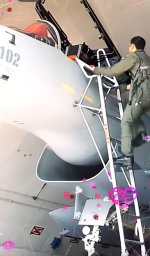
PAF J-10CE News, Updates and Discussion

Status
Not open for further replies.
It's takes lots of time to develop stealth version of JF-17 we will have to re-design whole it from nose to tail

What do you think AZM and PFX were trying to accomplish? And what's the outcome of PFX-Alpha and later a 5th gen platform? These are based on JF-17 buddy.....

Now if I were to do it, I'd go the J-10C route and create a stealthy canard smaller brother of J-20. That seems economical, industry gets matured and we get top end capability both for 4.5 gen J-10C and 5th gen future version.
 
What do you think AZM and PFX were trying to accomplish? And what's the outcome of PFX-Alpha and later a 5th gen platform? These are based on JF-17 buddy.....

You can't take non 5th and turn it into a 5th gen, turning the JF-17 into a 5th gen is more of a Hassle than designing a fifth gen from scratch.
 
Sou
What do you think AZM and PFX were trying to accomplish? And what's the outcome of PFX-Alpha and later a 5th gen platform? These are based on JF-17 buddy.....
Source, or you're just speculating? Where do you get from this information that AZM/PFX is based on JF-17?
 
Sou
Source, or you're just speculating? Where do you get from this information that AZM/PFX is based on JF-17?


Time is the teller of everything. You don't seem to watch defense related news, etc? Most of this stuff is public knowledge now.
 
What do you think AZM and PFX were trying to accomplish? And what's the outcome of PFX-Alpha and later a 5th gen platform? These are based on JF-17 buddy.....

Now if I were to do it, I'd go the J-10C route and create a stealthy canard smaller brother of J-20. That seems economical, industry gets matured and we get top end capability both for 4.5 gen J-10C and 5th gen future version.
The idea of creating a stealthier version of the JF-17 or even the J-10C often gets thrown around without a proper understanding of what that really entails both technically and financially. You’re drawing a loose comparison to efforts like the F-15 Silent Eagle or the later Su-35 variants, which do feature some reductions in radar cross-section (RCS), but you’re missing the full picture. This isn’t just a matter of reshaping a few panels and slapping on RAM (radar-absorbing material).

RCS reduction is not linear, nor is it plug-and-play.

RCS reduction is a systems-level design philosophy. You cannot just reduce the aircraft’s frontal profile or add coatings and expect dramatic results. That is why true stealth platforms like the F-22 or B-2 are built from the ground up around low observability. Every inlet, edge alignment, internal bay design, engine nozzle shape, and surface treatment is optimized for signature suppression. In contrast, legacy airframes like the JF-17 or J-10C have not been designed this way. Their internal geometry, external hardpoints, and aerodynamic shaping are not conducive to VLO (very low observability) optimization.

Even in Western programs, partial stealth upgrades have limitations. Take the F/A-18E/F Super Hornet, for example. Boeing put significant effort into reducing its frontal RCS compared to the older Hornet. But the moment you hang external fuel tanks, targeting pods, or air-to-air missiles under the wings, the benefit drops sharply. External stores become dominant RCS contributors. This is why aircraft like the F-35 carry weapons internally. Without internal bays, stealth becomes highly conditional.

The KF-21 Boramae is a textbook example of this intermediate approach. It is a reduced RCS platform, not a stealth platform. It features some shaping elements for frontal RCS control and RAM treatment, but it lacks internal bays and has conventional engine exhausts. It is designed to lower detectability in certain scenarios, not disappear from the battlespace. And even this program, backed by South Korean defense industry and Lockheed Martin tech transfer, costs billions.

Now apply that to PAC and it is even more difficult because there is no evidence it has the capacity to design and integrate a true stealth upgrade to an existing platform. Even modest RCS reduction would require re-engineering the airframe, redesigning intakes, modifying avionics architecture, integrating RAM coatings with sustainable lifecycle support, and re-certifying aerodynamic performance.

Pakistan does not have the industrial base, testing infrastructure, or software ecosystems to pull this off alone. Stealth is not just about shaping metal. It involves computational fluid dynamics, electromagnetic signature modeling, advanced materials science, radar signature testing, and long-term maintenance planning. All of these are expensive and require sustained investment.

The why is important too.

A stealthified JF-17 would cost significantly more without delivering near-peer survivability. You end up spending resources on partial improvements without reaching the threshold where it changes the operational equation. It’s the classic case of diminishing returns. For a country that relies on budget flexibility, donor funds, and subsidized imports, this is not the kind of project that returns strategic value.
 
High-end technology needs to be supported by basic industrial and technological capabilities, rather than being dependent on design capabilities. It is like the PC games that many people have played.

PC games have improved very much over the decades in terms of graphics quality content and so on. Is this because people decades ago were not as good at designing as people today? No, it's because the PC hardware to support the game, the software to support the design, and so on were not available at that time. The environment at the time could not support the games that run today.

The same goes for high end technology, when the underlying industrial and technological capabilities are not up to the task, even if the design drawings are given to you, you can't build it.

Senselessly sowing seeds on land destined for no harvest. It's actually wasteful.

Pakistan can learn from South Korea and Japan. South Korea's “indigenous destroyer” is actually a modified version of the Burke, with subsystems almost entirely from the United States. Japan's F2 is actually a modified version of the F-16, with almost all of its subsystems coming from the United States.
 
The idea of creating a stealthier version of the JF-17 or even the J-10C often gets thrown around without a proper understanding of what that really entails both technically and financially. You’re drawing a loose comparison to efforts like the F-15 Silent Eagle or the later Su-35 variants, which do feature some reductions in radar cross-section (RCS), but you’re missing the full picture. This isn’t just a matter of reshaping a few panels and slapping on RAM (radar-absorbing material).

RCS reduction is not linear, nor is it plug-and-play.

RCS reduction is a systems-level design philosophy. You cannot just reduce the aircraft’s frontal profile or add coatings and expect dramatic results. That is why true stealth platforms like the F-22 or B-2 are built from the ground up around low observability. Every inlet, edge alignment, internal bay design, engine nozzle shape, and surface treatment is optimized for signature suppression. In contrast, legacy airframes like the JF-17 or J-10C have not been designed this way. Their internal geometry, external hardpoints, and aerodynamic shaping are not conducive to VLO (very low observability) optimization.

Even in Western programs, partial stealth upgrades have limitations. Take the F/A-18E/F Super Hornet, for example. Boeing put significant effort into reducing its frontal RCS compared to the older Hornet. But the moment you hang external fuel tanks, targeting pods, or air-to-air missiles under the wings, the benefit drops sharply. External stores become dominant RCS contributors. This is why aircraft like the F-35 carry weapons internally. Without internal bays, stealth becomes highly conditional.

The KF-21 Boramae is a textbook example of this intermediate approach. It is a reduced RCS platform, not a stealth platform. It features some shaping elements for frontal RCS control and RAM treatment, but it lacks internal bays and has conventional engine exhausts. It is designed to lower detectability in certain scenarios, not disappear from the battlespace. And even this program, backed by South Korean defense industry and Lockheed Martin tech transfer, costs billions.

Now apply that to PAC and it is even more difficult because there is no evidence it has the capacity to design and integrate a true stealth upgrade to an existing platform. Even modest RCS reduction would require re-engineering the airframe, redesigning intakes, modifying avionics architecture, integrating RAM coatings with sustainable lifecycle support, and re-certifying aerodynamic performance.

Pakistan does not have the industrial base, testing infrastructure, or software ecosystems to pull this off alone. Stealth is not just about shaping metal. It involves computational fluid dynamics, electromagnetic signature modeling, advanced materials science, radar signature testing, and long-term maintenance planning. All of these are expensive and require sustained investment.

The why is important too.

A stealthified JF-17 would cost significantly more without delivering near-peer survivability. You end up spending resources on partial improvements without reaching the threshold where it changes the operational equation. It’s the classic case of diminishing returns. For a country that relies on budget flexibility, donor funds, and subsidized imports, this is not the kind of project that returns strategic value.
Quite frankly, even Pakistan being able to manufacture and manage the JF-17 ecosystem locally bar the engines would be a major achievement.

From a cost-benefit analysis, a UCAV design might make the most sense. Something resembling the Anka or Kizilelma.
 
Quite frankly, even Pakistan being able to manufacture and manage the JF-17 ecosystem locally bar the engines would be a major achievement.
Do you mean 100% local manufacturing? (Except engines)

In the Chinese perception, local manufacturing means that the local manufacturing rate of the product, from raw materials to the final product, is at least 80%. ------ Focus: Starting from raw materials......

If we use this standard to measure the local manufacturing rate of JF-17......
I don't think Pakistan has any real intention to increase the local manufacturing rate of JF-17. (Political propaganda slogans are not in the scope of discussion.)
 
Quite frankly, even Pakistan being able to manufacture and manage the JF-17 ecosystem locally bar the engines would be a major achievement.

From a cost-benefit analysis, a UCAV design might make the most sense. Something resembling the Anka or Kizilelma.

If Pakistan can independently produce all the subsystems of the JF-17 excluding the engine. This is enough to prove that Pakistan's aerospace industry level has at least surpassed Israel's and is one of the few best in the world.

Rafale's subsystems are from France,USA,Italy,etc.
EF-2000's subsystems are from UK,Germany,Italy,Spain,etc.
JAS-39's subsystems are from Sweden,UK,USA,Germany,etc.
 
If Pakistan can independently produce all the subsystems of the JF-17 excluding the engine. This is enough to prove that Pakistan's aerospace industry level has at least surpassed Israel's and is one of the few best in the world.

Rafale's subsystems are from France,USA,Italy,etc.
EF-2000's subsystems are from UK,Germany,Italy,Spain,etc.
JAS-39's subsystems are from Sweden,UK,USA,Germany,etc.
I think using Israel as a benchmark is quite flawed considering the size of the country, it is 10 million people. No doubt it carries more than its weight in economic and technological capacity but in the long-term I think a population of 200 million can aim higher even within the realm of feasibility, a future benchmark should not be restricted to Israel-level capacity but more-so a middle power's capacity — like Japan, Turkey, Germany, etc. As a longer term future goal.

I know many zealots have Israel-centric view here, but I don't agree with that restrictive perspective.
 
Status
Not open for further replies.

Users who are viewing this thread

Back
Top