Pakistan Weather News / Updates

All major water reservoirs ‘filled to brim’


Khalid Hasnain
October 10, 2025

LAHORE: Mangla Dam, Pakistan’s largest reservoir in terms of storage capacity, reached its maximum conservation level of 1,242 feet on Thursday, and now stores 7.277 million acre-feet (MAF) of water, according to Wapda.

Now, all three of the country’s main water reservoirs — Tarbela, Mangla and Chashma — are filled to their maximum levels, holding a cumulative live storage of 13.316 MAF, considered a boon for irrigated agriculture and hydroelectric power generation.

“Tarbela Dam attained its maximum water conservation level of 1,550 feet on Aug.21, followed by Chashma lake that also attained its maximum level of 649 feet above mean sea level,” an official source told Dawn. “And, finally on Thursday [Mangla] also hit its maximum level of 1,242 feet.”

The official attributed the filling of the reservoirs to a high-flow season.
 
Pakistan is likely to face one of its coldest winter this year in decades due to the La Nina climate pattern.

According to the latest situation report on Pakistan’s monsoon floods, compiled by the Intersector Coordination Group in collaboration with other partners, this could lead to colder-than-usual winter conditions, further stretching coping mechanisms of households affected by the floods, particularly in the mountainous regions of Khyber Pakhtunkhwa and Gilgit Baltistan.

Read more here: https://www.dawn.com/news/1948753/pakistan-may-witness-coldest-winter-in-decades
 
ISLAMABAD: Pakistan is likely to face one of its coldest winter this year in decades due to the La Nina climate pattern.

According to the latest situation report on Pakistan’s monsoon floods, compiled by the Intersector Coordination Group in collaboration with other partners, this could lead to colder-than-usual winter conditions, further stretching coping mechanisms of households affected by the floods, particularly in the mountainous regions of Khyber Pakhtunkhwa and Gilgit Baltistan.

A La Nina occurs when sea surface temperatures in the Pacific Ocean cool abnormally, triggering extreme weather shifts worldwide.

In its forecast for October, the report published by UN-OCHA says that the continued marginally negative phases of both the El Niño Southern Oscillation and the Indian Ocean Dipole will drive rainfall across Pakistan.

Northern Punjab, KP, AJK, and GB are likely to witness below-normal rainfall, while southern areas like Sindh, Balochistan, and southern Punjab may receive near-normal precipitation, it noted.

According to the report, the expected impacts of this phenomenon include possible disruptions to Kharif crop harvesting due to isolated storms, increased risk of dengue outbreaks in stagnant water conditions, higher chances of glacial lake outburst floods in upper areas, reduced river inflows affecting irrigation, elevated smog and air pollution in plains, and adverse effects on livestock health and fodder availability due to above-normal temperatures.

The report also takes stock of the deteriorating post-flood situation, especially in the context of “a diminishing response capacity both by government and humanitarian partners”.

“Despite robust response by local and international actors at the onset of the crisis, three months since, the presence of humanitarian partners and response capacity on the ground decreased. Pre-positioned stocks and initial emergency funds were used, with humanitarian partners now seeking additional funding for sustained interventions to ensure provision of basic services during the transition period from a humanitarian response to that of early recovery,” the OCHA report says.

Of particular concern is the long-term damage to livelihoods, which threatens recovery and self-sustainability. Crop fields were flooded, devastating harvests, livestock and fodder were swept away, and farm machinery and agricultural tools were damaged or destroyed, wreaking havoc on livelihoods and chances of restarting income generating activities in the near future.

According to a recent geo-spatial impact assessment conducted by FAO in flood affected areas, flood waters inundated around 1.2 million hectares in Punjab, the country’s food basket, damaging major rice, cotton, and sugarcane fields. The disaster coincided with the critical window for Rabi crop planting, further threatening food security and livelihoods and the ability to bounce back.

Remaining stagnant water in some flood-affected areas is also of concern as it causes significant health risks, including outbreaks of waterborne diseases like cholera, diarrhea, and typhoid, as well as vector-borne diseases such as malaria and dengue, which thrive in these conditions.

With over 229,760 damaged or destroyed homes, many families continue to sleep outside, with little protection from the elements or vector-borne diseases carried by mosquitoes.

Schools and health facilities have lost essential supplies and damaged or covered in thick mud preventing the resumption of classes or provision of health services. Food and fodder stocks were either washed away or now lay waterlogged and rotten, increasing food insecurity and reliance on humanitarian food rations.
 

Murree issues advisory for tourists


The Newspaper's Staff Reporter
December 22, 2025

1766410807144.png

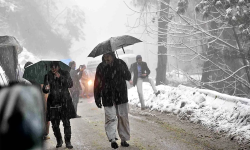
Undated image shows people walking under umbrellas during snowfall in Murree.— APP

RAWALPINDI: In view of the expected snowfall in Murree, Chief Traffic Officer (CTO) Murree Imran Razaq has issued a traffic advisory urging tourists to avoid unnecessary travel during bad weather and heavy snowfall, and to check the latest weather conditions and traffic situation before travelling.

A spokesman for the City Traffic Police Murree said that snowfall is continuing in Murree and that the traffic police are fully prepared to provide all possible facilities to tourists.

He said that additional traffic police personnel have been deployed across Murree to facilitate tourists and ensure smooth traffic flow.

CTO Murree Imran Razaq is personally supervising all traffic duties while remaining in the field, the spokesperson added.

According to the advisory, tourists travelling to Murree during snowfall should use fully equipped four-wheel-drive vehicles. Motorists are advised to keep their fuel tanks full and carry warm clothing.

The advisory further states that during snowfall, vehicles should not be parked in no-parking areas, over-speeding should be avoided and proper air pressure in tyres should be maintained while travelling towards Murree.

Citizens have been requested not to create double lanes under any circumstances during snowfall, the spokesman said.

Motorists are also advised to follow the instructions of traffic wardens deployed at various points during snowfall, as they play an important role in ensuring public safety and facilitating smooth travel, CTO Imran Razaq said.

In case of any traffic-related problems anywhere in Murree, citizens may contact the traffic control room at 051-9269200, he added.
 

Much-awaited rain ends dry spell in KP

Dawn Report
December 22, 2025

1766410932759.png

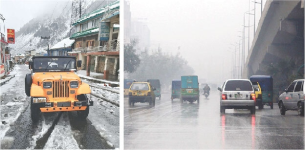
A four-wheeler moves slowly through Naran Bazaar amid snowfall. (Right)Motorists drive through GT Road, Peshawar, during rain. — Photo by Nisar Ahmed Khan/PPI

PESHAWAR: A much-awaited and intermittent rain on Sunday morning sharply dropped the temperature in the provincial capital and other parts of the province.

Residents of the provincial capital found themselves under the grip of a cold wave following light rain.

Also, the met department predicted more rains in the provincial capital, Swabi, Mardan, Karak, Kohat, Dir, Swat, Malakand, Abbottabat and other parts of the province.

Upper parts of Shangla district received fresh snowfall on Sunday, while plain areas were lashed by intermittent rain, causing a sharp drop in temperature and intensifying cold weather across the region.


According to local sources, snowfall was reported in Shangla Top, Yakhtangay, Spenghar, Gamtal, Kandaw and Kapar Banda, where hilltops were blanketed in white.

High-altitude areas receive snowfall

The snowfall disrupted routine life in high-altitude areas, while residents were seen staying indoors due to the harsh weather conditions.
 
The prolonged dry spell, which had led to a rise in respiratory tract infections, came to an end on Sunday as rain lashed the plains and snowfall occurred in the high-altitude areas of Hazara division.

The rain and snowfall, which began in scattered parts of the division in the early hours of Sunday, continued intermittently throughout the day, lowering temperatures.

Rain was reported in Mansehra, Torghar, Lower Kohistan, Upper Kohistan and Kolai-Palas districts.

High-altitude areas, including Kaghan Valley and Babusar Top in Mansehra, as well as Kandia and Spat valleys in Kohistan, received heavy snowfall.

Traffic between Khyber Pakhtunkhwa and Gilgit-Baltistan via the Mansehra-Naran-Jalkhad Road had already been suspended last month after heavy snowfall in Kaghan Valley.

Balakot assistant commissioner Hasrat Khan told reporters that traffic between the two federating units would remain suspended until summer next year, most likely in the first week of May.

A large number of patients suffering from respiratory tract infections have been moved to King Abdullah Teaching Hospital since the start of winter.

“If the current spell of rain continues to persist, most of the ailments caused by the dry spell and severe cold might decrease significantly,” a doctor said.

Published in Dawn, December 22nd, 2025
 

First winter rain brings chill, slush to twin cities


Aamir Yasin
December 22, 2025

1766411073731.png

A view of clouds on the sky during rainy and cold weather in Islamabad on Sunday. — Photo by Mohammad Asim/White Star

RAWALPINDI: The first winter rain lashed the twin cities on Sunday, bringing a chill to the air and creating a slushy mess in low-lying areas.

Light rain was recorded in Rawalpindi and Islamabad on Sunday, while the Met Office predicted more rain on Monday (today).

People woke up to a wet Sunday as rain started early in the morning, but the sun overpowered the clouds in the afternoon. However, light rain again occurred in various parts of the cities at night.

The chilly weather forced many people to stay indoors, though some ventured out to enjoy the pleasant conditions.


Narrow streets in the downtown areas witnessed a rush, particularly at traditional food outlets such as fish, siri paya and nihari shops, as people sought hot and traditional dishes to enjoy the winter rain and beat the cold breeze.

On the other hand, most areas of the city faced slushy conditions. Ongoing construction work at Kutchery Chowk under the remodelling project created a mess in and around the area.

The Met Office predicted rain, saying that a strong westerly wave was present over the northeastern parts of the country and was likely to persist in the upper regions until Monday.

A Met official said the westerly wave was affecting the western and upper parts of the country. “Rain and wind, with snowfall over mountains, are expected in upper Khyber Pakhtunkhwa, Gilgit-Baltistan and Kashmir. Cold and dry weather is likely to prevail in other parts of the country. Fog and smog are likely to persist over districts of eastern Punjab and upper Sindh,” he said.

The Met Office warned that landslides and snowfall could cause road closures and slippery conditions in Naran, Kaghan, Dir, Swat, Kohistan, Mansehra, Abbottabad, Shangla, Astore, Hunza, Skardu, Murree, Galiyat, Neelum Valley, Bagh, Poonch and Haveli today and tomorrow. An increase in fog intensity is also likely over districts of northeastern Punjab.
 
According to the Met Office, rainfall recorded included 5 millimetres (mm) in Murree, 1mm at Zero Point, Bokra and Saidpur in Islamabad, and 2mm at Shamsabad and 1mm at Gawalmandi, New Kattarian and Kutchery in Rawalpindi.

The Met official said temperatures would further drop in the coming days following rain and snowfall in the nearby hills.

“The rain has settled the dust and will reduce cases of cold and flu in Rawalpindi. This year, such cases increased in three government-run hospitals due to dry weather. Most patients have to experience cold and flu for about a week due to dust allergy,” said Dr Ahmed Ali of Holy Family Hospital.

He said people should use extra water to wash down dust particles in the upper respiratory tract and avoid going out in cold and dry weather.

Meanwhile, the light rain is beneficial for wheat farms, especially in the Potohar region, which relies on rainfall for agriculture in arid areas.

Muhammad Saleem, a farmer near Gujar Khan, said wheat was sown in November and there was a dire need for rain to support crop growth. “Though it was light rain, farmers are praying for more rainfall, which is necessary for the crops,” he said.
 

Murree braces for winter tourism

Aamir Yasin

1766411201824.png

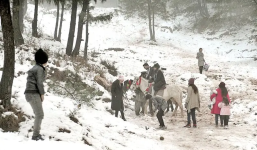
A family enjoys the snow in Murree —APP

RAWALPINDI: The district administration has completed all arrangements to facilitate tourists visiting Murree during the winter season and in the event of snowfall.

“Though there is no forecast of snowfall, the district administration has completed preparations for the winter season and established seven tourist facilitation centres in coordination with the Provincial Disaster Management Authority and the divisional commissioner,” said Murree Deputy Commissioner Agha Zaheer Shirazi while talking to Dawn.

He said that a mock exercise had been completed, while the Highway Department and other relevant departments had been provided with all available machinery to keep the roads clear.

He added that the district administration would maintain public safety, smooth traffic flow and uninterrupted essential services during snowfall and related emergencies.


Seven facilitation centres set up as departments placed on alert despite no snowfall forecast

He said that facilitation centres had been activated at key locations to assist tourists and residents through information sharing, route guidance, accommodation support and emergency response coordination.
 

Cold wave intensifies as snow blankets KP, Gilgit-Baltistan​


Another rain system expected to enter from Dec 27 to 31, potentially bringing rain to some districts of Punjab

Mubashir Islam
December 22, 2025

heavy rainfall in upper khyber pakhtunkhwa gilgit baltistan


Heavy rainfall in Upper Khyber-Pakhtunkhwa, Gilgit Baltistan

Upper areas of Khyber Pakhtunkhwa and Gilgit-Baltistan continued to experience severe cold on Monday as heavy rain and snowfall disrupted road connectivity, the Pakistan Meteorological Department said.

In Peshawar and surrounding areas, rainfall lowered temperatures to around 11°C, with cloudy conditions expected to persist over the next 24 hours.

Intermittent rain and snowfall continued in Upper and Lower Dir, with up to one foot of snow reported in parts of Kumrat Valley, Jaaz Banda and along the Lowari Tunnel route.

Cold conditions intensified across the Galiyat region, where heavy rain and snowfall were reported for a second consecutive day. Authorities advised residents and visitors to avoid unnecessary travel due to the likelihood of further snowfall.

Light rain in Abbottabad further lowered temperatures, while Nathiagali, Ayubia and Dungagali continued to receive heavy precipitation.
 

New year delight for tourists as northern valleys set to receive fresh snowfall​


PMD forecasts widespread rain, snowfall from Dec 30 through January 02 covering major tourist destinations

Web Desk
December 27, 2025


tribune


Pakistan’s picturesque northern valleys and hill stations are set to receive a heavy spell of fresh snowfall just in time for New Year celebrations, offering thousands of winter vacationers the perfect backdrop for their holiday getaways, Associated Press of Pakistan reported.

As families take advantage of winter school holidays and office workers utilise their remaining annual leave before year-end expiry, tourists from across the country have flocked to scenic mountainous regions to experience snowfall while celebrating the arrival of 2026.

The Pakistan Meteorological Department (PMD) has forecast widespread rain and snowfall from December 30 through January 02, 2026, covering major tourist destinations including Murree, Swat, Hunza, Naran and the Kashmir valleys — ideal conditions for those who planned their vacations to witness the magic of winter.

The National Weather Forecasting Centre said a westerly wave is expected to enter western parts of Pakistan from the night of December 29 and intensify from December 30. The system is anticipated to affect most upper and central parts of the country on December 31 and persist in northern regions until the morning of January 02, 2026.

The timing coincides with peak winter tourism, when hotels and guesthouses in northern areas are fully booked with families and professionals eager to welcome the new year amid snow-covered mountains and pristine valleys.
 
To view this content we will need your consent to set third party cookies.
For more detailed information, see our cookies page.
 
In Balochistan, rain, wind and thunderstorms with snowfall over the hills are expected in Quetta, Ziarat, Chaman, Pishin, Qilla Abdullah, Qilla Saifullah, Noshki, Harnai, Zhob, Kalat, Barkhan, Sibi, Loralai, Musakhel, Turbat, Gwadar, Jiwani, Lasbela, Kech, Awaran, Chagai, Panjgur, Khuzdar, Washuk and Kharan from the night of December 29 to December 31, with occasional breaks.

In Sindh, isolated light rain and drizzle are likely in Karachi, Hyderabad, Dadu, Jacobabad, Kashmore, Larkana, Thatta and Badin on December 30.
 

The year the rivers reclaimed their routes​


Floods that struck Punjab in 2025 are now being described as the most devastating deluge in the province’s history

Muhammad Ilyas
December 27, 2025


over 290 people lost their lives 6 5 million people were impacted while 162 542 houses were damaged across 27 districts during floods in punjab photo afp


Over 290 people lost their lives, 6.5 million people were impacted while 162,542 houses were damaged across 27 districts during floods in Punjab. PHOTO: AFP


LAHORE: For the first time in nearly three to four decades, Punjab’s rivers swelled to unprecedented levels, breaching protective embankments and inflicting severe damage on human life, agriculture, and the province’s economic infrastructure.

The catastrophic floods hit in the third week of August 2025, when monsoon rains broke all previous records. Continuous torrential rainfall caused dangerous surges in the Ravi, Sutlej, Chenab, and Jhelum rivers.

The Meteorological Department stated that the monsoon season arrived earlier than usual this year, resulting in river flooding of an intensity not seen since 1988 and 1992. Water levels rose several times above normal, overwhelming natural flow systems and flood-control structures.

Official figures showed that more than 27 districts of Punjab were severely affected, including Lahore, Multan, Muzaffargarh, Rajanpur, Dera Ghazi Khan, Jhang, Chiniot, Hafizabad, Sialkot, and Gujrat. As a result of the flooding, over 290 people lost their lives, 6.5 million people were affected, while 4,700 villages suffered damage. In low-lying areas, floodwaters damaged homes, destroyed underpasses and washed away roads, further disrupting daily life and transport.

Residents of Lahore’s Theme Park area reported that their homes were swept away by floodwaters and that they were still awaiting government assistance. For instance, Syed Muhammad Farooq, a resident of the area, revealed that the floods hit in August, destroying house floors and furniture. “No relief has been provided by the Punjab government till date,” said Farooq, who demanded immediate compensation from the government.

Similarly, residents of Kasur shared that they rebuilt their homes themselves since government assistance was still pending. “After flood surveys were conducted, financial assistance of Rs150,000 was announced. I received a card and letter in November, but when I went for biometric verification, I was told that no funds had been credited to the card. Despite filing an online complaint with the Chief Minister’s office and repeated calls to PDMA, the issue remains unresolved,” revealed Raja Sohail Bakhsh, an affectee.

According to data obtained from the Provincial Disaster Management Authority (PDMA), field surveys collected data from 594,000 families. The floods affected 1.46 million acres of agricultural land, including rice crops at 44 per cent, maize at 24 per cent, cotton at nine per cent and sesame at seven per cent. A total of 162,542 houses were damaged, of which 69 per cent were mud houses, and 31 per cent were brick structures.

Additionally, 5,458 livestock were affected, including cows and buffaloes at 64 per cent, sheep and goats at 18 per cent, calves at 16 per cent, and horses or donkeys at two per cent.
 

KP in grip of severe cold after rain, snowfall

Dawn Report
December 31, 2025

1767188020379.png

Two men stand near a vehicle which skidded off a snowy road in Oveerik village of Injigan valley, Chitral, on Tuesday. — Dawn

CHITRAL: A cold wave swept across Khyber Pakhtunkhwa on Tuesday after intermittent rainfall in plain areas and snowfall in upper regions.

A drop in temperatures was reported across the length and breadth of Chitral region.

Four inches of snow fell on the Lowari Tunnel Road, which connects Chitral to other parts of the country. However, vehicular traffic remained unaffected.

Snowfall was also reported in Chitral’s Laspur Valley, Reach, Trich, Madak Lisht, Arkari, Karimabad and Gabor areas.


A vehicle belonging to NGO Aga Khan Agency for Habitat and with the driver and two engineers on board, crashed into a ditch in the Awerik village in the Anjigan Valley of Lower Chitral. However, they all remained unhurt. They’re shifted to the Garm Chashma tehsil headquarters hospital.

The incident occurred as the driver lost control of the vehicle on the slippery road due to snowfall.

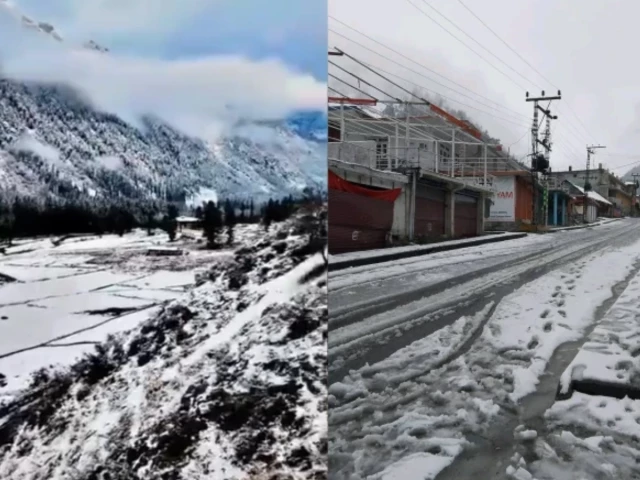
Several mountainous areas of Lower and Upper South Waziristan districts reported the first rain and snowfall of the winter season, marking the onset of colder weather and bringing relief to residents and farmers from a prolonged dry spell.

The residents said light to moderate snowfall was recorded in high-altitude regions, including Angoor Adda, Shakai, Khamrang, Raghzai, Kaniguram, Badar, Laddha and surrounding hilly areas, while intermittent downpour fell in low areas.

They said the precipitation transformed the mountainous landscape, with hill ranges blanketed in snow, significantly enhancing the natural beauty of the region.

Residents welcomed the change in weather, describing the snowfall and rain as a positive and refreshing development after a dry spell. They hoped that the cold weather would offer environmental and economic benefits to the region.
 

Users who are viewing this thread

Pakistan Defence Latest

Country Watch Latest

Latest Posts

Back
Top